
Agriculture Drone Mapping | NDVI & Crop Analysis
UAV agriculture mapping for NDVI, crop health, stand count, and PMFBY damage assessment. Precision farming with accurate aerial field data.
Agriculture Drone Mapping | NDVI & Crop Analysis
UAV agriculture mapping for NDVI, crop health, stand count, and PMFBY damage assessment. Precision farming with accurate aerial field data.
Table Of Content
- Precision Agriculture Drone Mapping and Aerial Survey: See Every Problem Zone in Your Field Before It Costs You a Harvest
- Why Manual Scouting Fails on Large Agricultural Fields
- Drone Agriculture Mapping: One Flight. The Entire Field. Actionable Crop Health Maps the Same Day.
- Multispectral Crop Health Mapping: See Stress, Deficiency, and Disease Before Yield Is Lost
- Stand Count & Plant Population Mapping Across the Entire Field - Not Just the Transect
- Variable Rate Application Maps and Drone Mapping Services: Direct Every Input to the Zones That Need It
- Drone-Based Crop Damage Assessment and Aerial Survey for Insurance Claims and Farm Management
- Season-Long Crop Monitoring with Repeat Drone Surveys
- Trial Plot Analytics with Drone Data: Measure Performance with Precision
- LiDAR for Agriculture: Precision Land Leveling, Drainage & Terrain Analysis
- Who Uses Aeroyantra for Agriculture Drone Mapping
- Complete Deliverables for Agricultural Drone Mapping
- Frequently Asked Questions
- Ready to See Every Problem Zone in Your Field Before It Costs You a Harvest?
Precision Agriculture Drone Mapping and Aerial Survey: See Every Problem Zone in Your Field Before It Costs You a Harvest
By the time a stress zone is visible to a walking scout, the crop in that zone has already lost yield potential. By the time inputs are applied uniformly across a 200-acre field, a significant portion of that input has been wasted on areas that did not need it.
Aeroyantra is a cloud-based precision agriculture drone mapping platform that converts RGB, multispectral, and LiDAR data into actionable field intelligence for crop health monitoring, stand count analysis, and variable rate application. We give agronomists, farm managers, and agricultural service providers a fast, accurate view of every field - stand counts, stress zones, nutrient variation, and treatment response - from a single aerial survey drone flight, processed into actionable maps your team can use the same day using our drone mapping software and aerial photogrammetry.
Why Manual Scouting Fails on Large Agricultural Fields
Manual field scouting on large farms is a fundamental data problem. A scout walking transects across a 100-acre field covers a small fraction of the crop canopy, misses the variation between transect lines, and produces observations that are already hours old by the time they reach the agronomist. On a 500-acre farm across multiple fields, consistent manual scouting is practically impossible.
The consequences are predictable and financially significant:
-
Stress and disease detected too late - Fungal infection, nutrient deficiency, and water stress that is visible in multispectral data at early onset does not become visible to a walking scout until the crop has already lost yield potential - sometimes by weeks
-
Inputs applied uniformly across variable fields - Fertilizer, pesticide, and irrigation applied at a uniform rate across an entire field means over-application in healthy zones and under-application in stressed zones - both outcomes costing money and yield
-
Poor stand establishment goes unmeasured - Gaps in plant population caused by poor germination, pest damage, or soil variability are not quantified without a stand count - so replanting decisions are made on guesswork
-
Storm and hail damage is difficult to quantify - Manual assessment of crop damage after a weather event is slow, inconsistent, and difficult to defend in an insurance claim
-
Treatment effectiveness is assumed, not measured - Without a post-treatment survey, the response to a pesticide or fertilizer application is assessed subjectively - making it impossible to optimize inputs across the season
-
Trial plot comparisons are imprecise - Seed trials, variety comparisons, and input trials assessed by walking observation produce results that are difficult to quantify and impossible to replicate
On large farms and across multi-field operations, the cost of these gaps accumulates across every season.
Drone Agriculture Mapping: One Flight. The Entire Field. Actionable Crop Health Maps the Same Day.
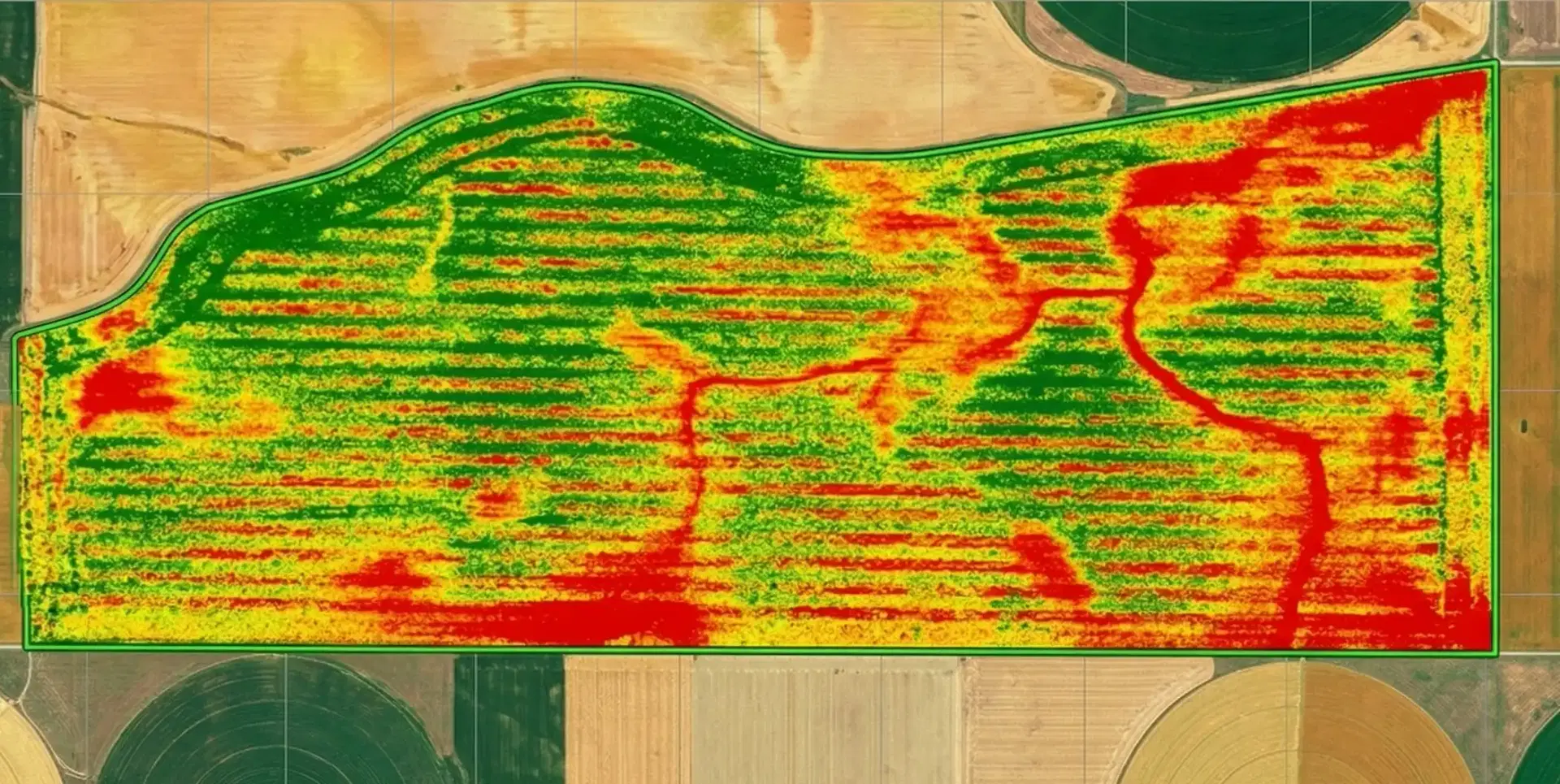
Aeroyantra converts a single aerial survey into a complete field health dataset - NDVI and NDRE vegetation maps, stand count data, stress zone identification, and variable rate application maps - processed in the cloud and ready for field use the same day as the flight using our drone surveying and mapping platform.
With RTK drone mapping workflows, Aeroyantra delivers georeferenced field maps accurate enough for variable rate application, precise enough for trial plot comparison, and fast enough to support in-season management decisions. Our drone mapping services and aerial mapping software provide comprehensive agricultural drone mapping and GIS mapping solutions.
What that means for your operation:
-
See the full field, not just the transect lines - Every square meter of the crop canopy captured and analyzed in a single aerial drone survey using drones for mapping
-
Detect stress at early onset - Multispectral analysis identifies stress before it is visible to the human eye, giving your team time to respond before yield is lost with drone survey mapping
-
Apply inputs where they are needed - Variable rate application maps generated from drone mapping data direct inputs to the zones that need them, reducing waste and improving response
-
Quantify stand establishment - Automatic stand counts from drone aerial mapping give you plant population data across the entire field within hours of emergence
-
Measure treatment response - Pre- and post-treatment surveys quantify the response to every input application, enabling season-long optimization with agriculture drone mapping
-
Document damage for insurance - Georeferenced crop damage maps provide defensible evidence for PMFBY and private crop insurance claims using aerial mapping drone technology
Multispectral Crop Health Mapping: See Stress, Deficiency, and Disease Before Yield Is Lost
Visible light imagery shows you what a field looks like. Multispectral imagery shows you how the crop is performing - at the cellular level, weeks before stress becomes visible to a scout.
Aeroyantra supports drone crop health monitoring with NDVI and NDRE analysis workflows that give agronomists and farm managers the early detection capability that transforms reactive crop management into proactive yield protection.
NDVI - Normalized Difference Vegetation Index
NDVI measures the difference between near-infrared and red light reflectance to quantify vegetation density and health. Healthy, dense crops reflect high near-infrared and low red light. Stressed, sparse, or damaged crops show reduced near-infrared reflectance.
What NDVI maps tell you:
- Overall crop vigor and canopy density across the field
- Zones of poor establishment, thinning, or early senescence
- Spatial patterns of stress that correlate with soil variability, drainage, or management zones
- Seasonal progression of crop development from emergence to maturity
NDRE - Normalized Difference Red Edge
NDRE uses the red edge band - a narrow spectral range between red and near-infrared - to detect chlorophyll content variation that NDVI misses in dense canopies. NDRE is more sensitive to early-stage nutrient stress, particularly nitrogen deficiency, in crops that have reached full canopy closure.
What NDRE maps tell you:
- Nitrogen and chlorophyll deficiency at early onset, before yield loss occurs
- Stress variation within dense canopies where NDVI saturates
- Precise delineation of management zones for variable rate nitrogen application
- Treatment response to foliar nutrition applications
Hyperspectral Analysis
Hyperspectral imaging captures dozens of narrow spectral bands across the visible and near-infrared spectrum, enabling detection of specific stress signatures that broadband multispectral sensors cannot distinguish.
What hyperspectral analysis detects:
- Specific fungal and bacterial disease signatures before visible symptoms appear
- Pest damage patterns at early infestation stages
- Weed species discrimination for targeted herbicide application
- Soil moisture variation and irrigation stress mapping
- Specific nutrient deficiencies distinguished by spectral signature
Stand Count & Plant Population Mapping Across the Entire Field - Not Just the Transect
Stand establishment is the foundation of yield potential. A field with 15% gaps in plant population will not deliver the yield the input programme was designed for - but those gaps will not be visible in a walking scout until it is too late to replant economically.
Aeroyantra automatic stand count from drone imagery gives you plant population data across the entire field within hours of emergence - so replanting decisions are made on measured data, not estimates.
What Aeroyantra delivers for stand count analysis:
-
Automatic plant detection - AI-powered plant detection from high-resolution drone imagery, counting individual plants across the full field
-
Population density mapping - Plants per hectare calculated at user-defined grid resolution across the entire field, identifying low-population zones
-
Gap identification and mapping - Georeferenced identification of establishment gaps above a defined size threshold for targeted replanting assessment
-
Row uniformity analysis - Row spacing consistency and intra-row gap analysis for precision-drilled crops
-
Emergence timing variation - Comparison of stand counts across multiple early-season surveys to identify delayed emergence zones
-
Trial plot population comparison - Precise plant population data for each trial plot in variety and seed rate trials
Variable Rate Application Maps and Drone Mapping Services: Direct Every Input to the Zones That Need It
Uniform input application across a variable field is an economically inefficient strategy that over-applies in high-performing zones and under-applies in stressed zones. Variable rate application - directing inputs to the zones that need them at the rates those zones require - is the most direct route from drone mapping data to measurable input cost reduction.
Aeroyantra generates variable rate prescription maps for precision agriculture from multispectral field data using drone surveying and mapping and aerial survey drone technology that can be loaded directly into compatible variable rate application equipment using our drone mapping services and aerial photogrammetry.
What Aeroyantra delivers for variable rate application:
-
Variable rate fertilizer maps - Zone-based nitrogen, phosphorus, and potassium application prescriptions derived from NDRE and NDVI field data using drone mapping software
-
Variable rate pesticide maps - Targeted pesticide application zones derived from stress and disease detection maps using aerial survey, reducing total pesticide use
-
AI spot spraying maps - Weed cluster identification and georeferenced spot spray prescriptions for targeted herbicide application with drone survey mapping
-
Irrigation zone maps - Water stress zone identification for variable rate or targeted irrigation management using aerial mapping drone
-
Prescription map export - Variable rate prescription maps exported in formats compatible with John Deere Operations Center, Trimble Ag Software, and major variable rate controller platforms using UAV mapping services
-
Treatment response tracking - Pre- and post-application survey comparison to measure the response to every variable rate application with drone agriculture mapping
Drone-Based Crop Damage Assessment and Aerial Survey for Insurance Claims and Farm Management
Storm damage, hail, flooding, pest infestation, and drought stress affect different parts of a field at different intensities. Manual damage assessment is slow, inconsistent across assessors, and difficult to defend in an insurance dispute. Drone-based crop damage assessment using drone surveying and mapping and aerial photogrammetry produces a georeferenced, quantified record of damage extent and severity within hours of an event using our drone mapping services and aerial survey drone technology.
What Aeroyantra delivers for crop damage assessment:
-
Damage extent mapping - Georeferenced mapping of damaged crop areas with total affected area quantified by zone and by field using drone survey mapping
-
Damage severity classification - Multispectral analysis classifying damage by severity using aerial mapping drone - total loss, partial loss, and marginal impact - for accurate insurance claim preparation
-
Pre- and post-event comparison - Damage assessment produced by comparing post-event survey against pre-event baseline using drone 3d mapping, providing defensible evidence of damage caused by the specific event
-
Insurance claim documentation - Georeferenced damage reports formatted to support crop insurance claims and government compensation applications with UAV mapping services
-
Rapid post-event turnaround - Damage assessment surveys conducted and processed within 24-48 hours of the event for timely claim submission using drone mapping software
-
Multi-field damage reports - Single-flight coverage of multiple fields for farm-wide damage quantification with aerial photogrammetry
Season-Long Crop Monitoring with Repeat Drone Surveys
A single drone survey gives you a snapshot. A series of surveys across the season gives you the data to understand how your crop is developing, where interventions worked, and what to do differently next season.
Aeroyantra supports season-long field monitoring with repeat surveys registered to a common datum, enabling comparison of crop development, treatment response, and yield potential across every field at every growth stage.
What Aeroyantra delivers for seasonal tracking:
-
Emergence and establishment surveys - Stand count and early vigor mapping at 2-4 weeks after planting
-
Vegetative growth monitoring - NDVI and NDRE surveys at key vegetative growth stages to identify stress and nutrient variation before yield potential is affected
-
Pre-flowering assessment - Full field health assessment before flowering to identify zones requiring intervention before the critical yield determination period
-
Post-treatment response surveys - Survey at 7-14 days post-application to measure treatment response and identify areas requiring follow-up
-
Pre-harvest yield potential mapping - Late-season NDVI mapping to identify yield potential variation across the field for harvest management
-
Season-end field comparison - End-of-season comparison of field performance against input records for agronomic analysis and next-season planning
Trial Plot Analytics with Drone Data: Measure Performance with Precision
Seed trials, variety comparisons, fertilizer rate trials, and crop protection product evaluations are only as good as the measurement method used to assess them. Walking observation introduces assessor variability, misses within-plot variation, and produces results that are difficult to quantify and impossible to replicate.
Aeroyantra delivers precise, quantified trial plot data from drone surveys - giving research teams, seed companies, and agrochemical manufacturers the measurement precision their trials require.
What Aeroyantra delivers for trial plot analytics:
-
Plot boundary mapping - Precise georeferenced boundaries for every trial plot, enabling exact comparison between treatments
-
Within-plot NDVI and NDRE analysis - Vegetation index values calculated for each plot individually, with within-plot variation quantified
-
Stand count by plot - Plant population measured for each plot separately for stand-adjusted performance comparison
-
Biomass estimation - Canopy height and volume estimation from 3D surface models for above-ground biomass comparison between treatments
-
Time-series plot comparison - Multiple surveys across the season producing a growth curve for each treatment plot
-
Statistical export - Plot-level data exported in CSV format for direct import into statistical analysis software
-
Side-by-side plot visualization - Browser-based visualization tool enabling direct comparison of any two plots from the same survey
LiDAR for Agriculture: Precision Land Leveling, Drainage & Terrain Analysis
Crop performance is as much a function of terrain as it is of agronomic management. Waterlogging in low-lying areas, drought stress on elevated zones, and drainage failures caused by subtle terrain variation all drive yield loss that no amount of input optimization can overcome if the underlying terrain is not understood.
Aeroyantra supports agricultural LiDAR terrain mapping for applications where photogrammetry DTM accuracy is insufficient for precision land leveling and drainage design.
What Aeroyantra delivers from agricultural LiDAR surveys:
-
High-accuracy Digital Terrain Model (DTM) - Bare-earth terrain model at 2-5 cm vertical accuracy for precision land leveling design and drainage planning
-
Precision land leveling design support - Cut-and-fill calculations for land leveling programs, optimizing material movement to achieve design grades
-
Drainage basin analysis - Terrain-derived catchment mapping identifying natural drainage pathways, ponding areas, and drainage outlet requirements
-
Waterlogging risk mapping - Identification of terrain depressions and low-lying areas prone to waterlogging under rainfall or irrigation events
-
Irrigation channel design support - Accurate terrain data for irrigation channel alignment, gradient design, and water distribution planning
-
Soil sampling zone optimization - Terrain-based management zone delineation for soil sampling program design
Who Uses Aeroyantra for Agriculture Drone Mapping
Growers and Farm Managers
Large farm operations managing multiple fields across kharif and rabi seasons. Aeroyantra replaces walking scouts with drone surveys that cover the full farm in a fraction of the time - giving farm managers the field data they need to make input decisions, respond to stress events, and track treatment effectiveness across every field.
Agronomists and Crop Consultants
Independent agronomists and crop consultants managing multiple client farms. Aeroyantra enables agronomists to cover more farms in less time, deliver quantified field health reports rather than subjective observations, and build variable rate prescriptions directly from drone data.
Seed Companies and Agricultural Manufacturers
Research and commercial production teams conducting variety trials, seed rate trials, and crop protection product evaluations. Aeroyantra delivers the measurement precision and data consistency that trial programs require.
Crop Insurance and Loss Assessment Teams
Insurance companies, loss adjusters, and government agencies conducting crop damage assessment. Aeroyantra enables rapid, consistent damage quantification across large farm areas with georeferenced documentation suitable for insurance claim submission.
Complete Deliverables for Agricultural Drone Mapping
| Deliverable | Crop Health | Stand Count | Variable Rate | Damage Assessment | Trial Plots |
|---|---|---|---|---|---|
| High-res RGB orthomosaic | ✓ | ✓ | ✓ | ✓ | ✓ |
| NDVI vegetation map | ✓ | - | ✓ | ✓ | ✓ |
| NDRE vegetation map | ✓ | - | ✓ | - | ✓ |
| Hyperspectral analysis | ✓ | - | ✓ | - | ✓ |
| Automatic stand count | - | ✓ | - | - | ✓ |
| Gap and population map | - | ✓ | - | - | ✓ |
| Variable rate prescription | - | - | ✓ | - | - |
| Spot spray weed map | - | - | ✓ | - | - |
| Damage extent map | - | - | - | ✓ | ✓ |
| Insurance claim report | - | - | - | ✓ | - |
| LiDAR terrain model | - | - | ✓ | - | - |
| Time-series comparison | ✓ | ✓ | ✓ | ✓ | ✓ |
| GIS-compatible exports | ✓ | ✓ | ✓ | ✓ | ✓ |
Frequently Asked Questions
Q1: What is the difference between NDVI and NDRE and when should I use each?
NDVI (Normalized Difference Vegetation Index) measures overall vegetation density and health using near-infrared and red bands. It is effective for detecting stress, sparse canopy, and damage across most crop types and growth stages. NDRE (Normalized Difference Red Edge) uses the red edge band to detect chlorophyll content variation within dense canopies where NDVI saturates. NDRE is more sensitive to early-stage nitrogen deficiency in crops that have reached full canopy closure - making it the preferred index for late-season nitrogen management in wheat, rice, and sugarcane. For most operations, Aeroyantra recommends NDVI for general field health monitoring and NDRE for in-season nitrogen management in dense canopy crops.
Q2: How accurate are Aeroyantra stand counts compared to manual plant counting?
Aeroyantra automatic stand counts from high-resolution drone imagery achieve accuracy of 95% or better for most row crops at early emergence stages under good imaging conditions. Accuracy depends on image resolution (GSD), crop growth stage, canopy overlap between plants, and lighting conditions at the time of flight. For most precision agriculture applications - replanting decisions, population comparisons, trial plot analysis - drone stand counts are significantly more accurate than manual transect counting because they cover the entire field rather than sampled transects.
Q3: Can Aeroyantra generate variable rate prescription maps compatible with my sprayer or spreader?
Yes. Aeroyantra generates variable rate prescription maps in formats compatible with major precision agriculture platforms including John Deere Operations Center, Trimble Ag Software, and standard ISOBUS-compatible variable rate controllers. Prescription maps are exported as georeferenced shapefiles or platform-specific formats depending on equipment requirements. We recommend confirming your specific equipment's prescription map format requirements before the first application.
Q4: Can Aeroyantra data be used for crop insurance claims?
Yes. Aeroyantra produces georeferenced, time-stamped crop damage reports that document damage extent and severity with quantified area measurements. These reports provide the aerial evidence required to support crop insurance claims and government compensation applications. Pre-event baseline surveys compared against post-event damage surveys provide the most defensible documentation for disputed claims.
Q5: How large an area can Aeroyantra cover in a single drone flight?
Coverage per flight depends on drone type, flight altitude, and GSD requirements. For standard multispectral surveys at 5-10 cm GSD, a single drone flight covers 50-150 acres per flight depending on altitude and field conditions. For large farms requiring higher coverage rates, multi-battery flights or multi-drone operations are available. A typical 500-acre farm can be fully surveyed in 3-5 flight cycles in a single day.
Q6: How soon after a flight are the NDVI and crop health maps available?
Aeroyantra processes flight data in the cloud and delivers NDVI maps, stand count results, and damage assessment reports within 24-48 hours of flight completion. For urgent post-event damage assessments, priority processing is available. Field maps can be reviewed on the Aeroyantra platform from any device - no software installation required.
Q7: Can Aeroyantra be used for precision land leveling and drainage design?
Yes. Aeroyantra supports LiDAR terrain mapping for precision land leveling and drainage design applications. LiDAR surveys produce high-accuracy Digital Terrain Models at 2-5 cm vertical accuracy, suitable for land leveling cut-and-fill calculations, drainage basin analysis, and irrigation channel design. For farms where terrain variation is driving waterlogging or drought stress, a LiDAR terrain survey is the foundation for addressing the underlying cause.
Q8: Is Aeroyantra suitable for small farms or only large operations?
Aeroyantra is designed for large farms and multi-field operations where the efficiency advantage of drone mapping over manual scouting is most significant. For individual farms below approximately 25 acres, the economics of drone mapping depend on the specific use case - stand counts, damage assessment, and trial plot analysis deliver value at smaller scales than general crop health monitoring. Aeroyantra is most cost-effective for operations managing 100 acres or more across multiple fields or for service providers covering multiple client farms per day.
Ready to See Every Problem Zone in Your Field Before It Costs You a Harvest?
Whether you are managing crop health across a large farm, building variable rate prescriptions for your clients, conducting seed trials, or assessing storm damage for insurance, Aeroyantra gives you the aerial field data to make decisions based on measurements - not guesswork.
Other Industries We Serve
Discover how Aeroyantra delivers survey-grade drone mapping across different sectors
Mining & Quarrying
Stockpile volumes, pit progression, and compliance documentation
Construction
Earthworks monitoring, cut/fill analysis, and as-built verification
Roads & Highways
Corridor mapping, alignment verification, and progress tracking
Rail & Linear Infrastructure
Corridor monitoring, embankment tracking, and ROW verification
Industrial & EPC
Site planning, structural inspection, and facility documentation
Waste Management
Landfill volume tracking, cell progression, and compliance
Smart City & Urban Works
Urban planning, land use monitoring, and GIS mapping
Oil & Gas
Pipeline monitoring, facility inspection, and thermal imaging
Solar
Panel inspection, performance monitoring, and hot spot detection
Owners & Developers
Independent progress verification and quantity validation