
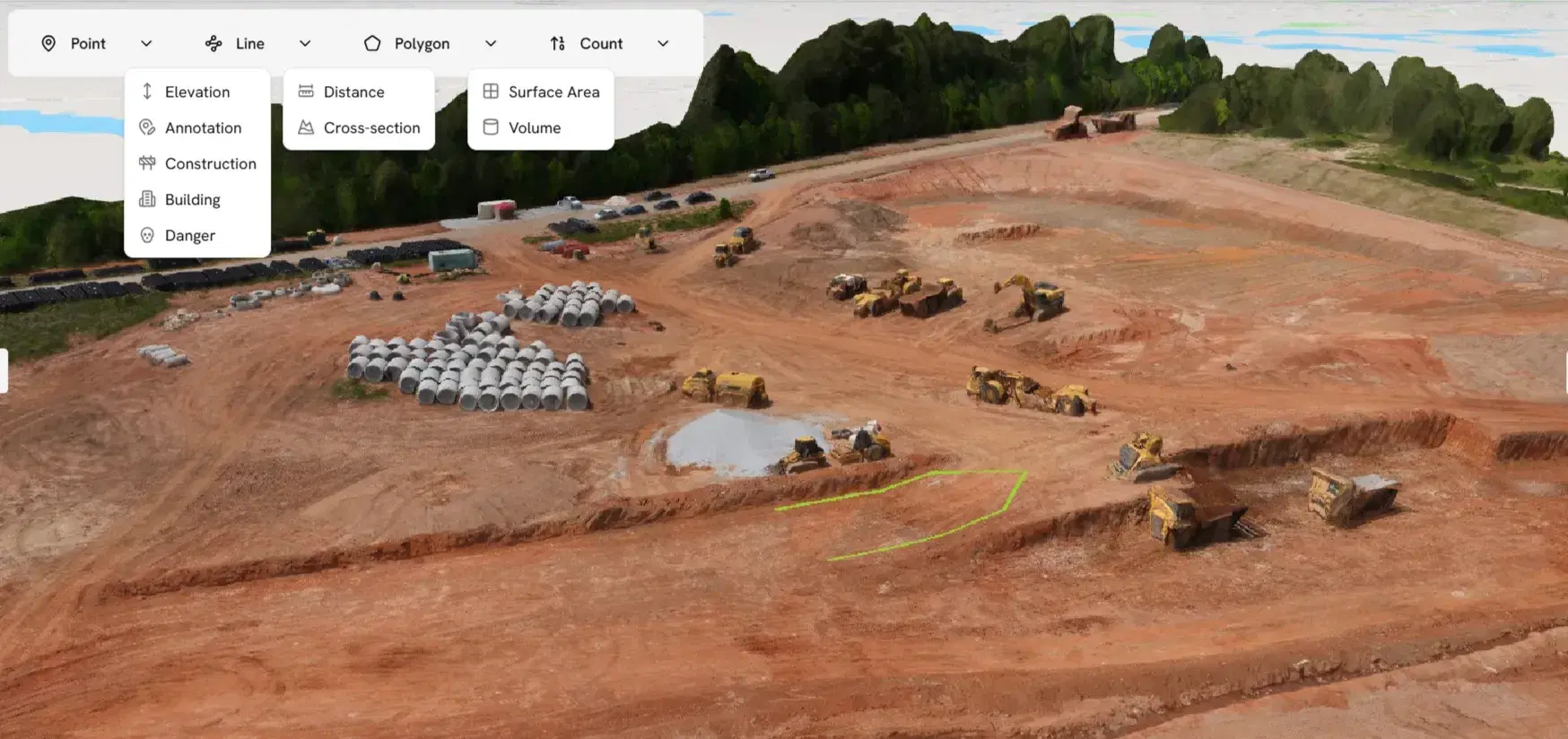
Drone Mapping for Construction | Earthwork & Progress
Drone survey for construction projects. Cut/fill volume, as-built verification, progress tracking, and site documentation with survey-grade aerial data.
Drone Mapping for Construction | Earthwork & Progress
Drone survey for construction projects. Cut/fill volume, as-built verification, progress tracking, and site documentation with survey-grade aerial data.
Table Of Content
- Drone Surveying and Mapping for Construction: Catch Grading Errors Before Compaction. Not After.
- On Large Construction Sites, Problems Are Found After the Work Has Already Moved Forward Without Site-Wide Measurement
- Drone Mapping Services: One Flight. The Entire Site. Survey-Grade Construction Data in 24-48 Hours.
- Drone 3D Mapping for Earthworks Monitoring: Measure What Moved. Validate Before Billing. Prevent Disputes Before They Start.
- As-Built Verification and Drone Survey Mapping: Know Whether What Was Built Matches What Was Designed - Before the Next Layer Goes Down
- Construction Progress Tracking and Drone Mapping Services Your Entire Project Team Works From
- LiDAR Survey and Drone Lidar Mapping for Construction: High-Precision Reality Capture Where Photogrammetry Has Limits
- Survey-Grade Construction Reality Capture at Every Critical Project Phase
- One Source of Site Data. Every Team. Every Decision.
- Complete Deliverables for Construction Projects
- Who Uses Aeroyantra on Construction Projects
- Frequently Asked Questions
- Ready to Catch Construction Problems at the Phase Where Fixing Them Is Still Affordable?
Drone Surveying and Mapping for Construction: Catch Grading Errors Before Compaction. Not After.
Grading deviations found after compaction mean breaking finished work. Subgrade issues found after asphalt placement mean cutting and relaying. Cut/fill quantities that drift from design targets mean billing disputes that take months to resolve.
Aeroyantra is a construction drone mapping and reality capture platform that converts aerial imagery and LiDAR data into survey-grade surfaces, cut/fill volumes, and as-built comparison datasets. Our drone survey services and aerial mapping software give construction teams the aerial data to catch these problems at the phase where fixing them costs a fraction of what they cost later - with survey-grade drone surveying and mapping and GIS mapping that covers the entire site in a single flight, processed and ready for engineering review within 24-48 hours.
On Large Construction Sites, Problems Are Found After the Work Has Already Moved Forward Without Site-Wide Measurement
The fundamental challenge on large construction sites is not a lack of effort - it is a lack of current, site-wide data. Ground-based survey teams cover limited areas, work slowly across large sites, and produce reports that are out of date by the time they reach the project manager.
The result is a consistent pattern of problems that repeat across projects regardless of contractor experience:
-
Grade deviations discovered after compaction - Subgrade that is 50-100 mm off design is not visible to a walking inspection. It shows up in a survey - and by then, compaction is done and breaking it out is the only option
-
Subgrade issues found after asphalt placement - Soft spots, inadequate compaction, and drainage problems that were not detected at subgrade stage become defects after pavement is laid
-
Cut/fill quantities that drift from design targets - Without weekly measured volumes, earthwork quantities accumulate variance that surfaces as a billing dispute at the end of the month
-
Over-excavation during foundation work - Foundation excavations that go beyond design depth are discovered when concrete is poured - not before
-
Drawings that no longer match site conditions - Design drawings that were accurate at tender become unreliable as site conditions evolve, and teams making decisions from outdated drawings make the wrong decisions
-
Disputes with no independent record - When contractor and client disagree on progress, quantities, or condition, the absence of a contemporaneous site record means the dispute is resolved by negotiation rather than evidence
By the time any of these problems appears in a project meeting, the cost of correction has already compounded.
Don't have a drone team?
Our DGCA-certified pilots survey your construction site and deliver results in 48 hours - no equipment, no software required.
Drone Mapping Services: One Flight. The Entire Site. Survey-Grade Construction Data in 24-48 Hours.
Aeroyantra replaces slow, partial, labor-intensive ground surveys with a single aerial survey drone flight that captures the entire construction site - processed into engineering-grade outputs that contractors, surveyors, and project managers can measure, compare, and act on. Our drone survey mapping and aerial photogrammetry workflows deliver precision data for construction monitoring.
With RTK, PPK, and GCP-supported workflows, Aeroyantra achieves 2-3 cm horizontal accuracy and vertical precision suitable for earthwork validation, grade control, and quantity reconciliation across construction sites of any scale.
What that means in practice:
-
Spot grading issues before compaction starts - Survey the subgrade surface before the compaction crew moves in, compare against design, and correct deviations while the ground is still workable
-
Verify subgrade before asphalt placement - Independent measurement of subgrade levels and condition before each pavement layer is placed
-
Track cut/fill quantities weekly against design - Measured volume reports at every survey cycle, tied to billing milestones, providing an independent basis for quantity certification
-
Compare as-built against CAD and BIM - Current site condition overlaid against design drawings with deviation heatmap showing where construction matches design and where it does not
-
Cover the full site in a single flight - No more partial surveys that miss the areas where problems are developing
Drone 3D Mapping for Earthworks Monitoring: Measure What Moved. Validate Before Billing. Prevent Disputes Before They Start.
Earthwork is where construction projects most consistently lose margin - and where drone mapping for construction delivers the clearest, fastest return. Manual cross-section methods introduce quantity variance of 5-15% on large earthwork packages. That variance becomes a billing dispute. Aeroyantra's aerial drone survey and photogrammetry software replace estimation with measurement using drones for surveying and mapping.
This makes Aeroyantra a practical system for continuous earthworks monitoring and cut/fill quantity control on large construction sites.
What Aeroyantra delivers for earthworks monitoring:
-
Cut volume quantification - Precise measurement of material removed from cut areas by zone and by total site, derived from surface model comparison using drone mapping software
-
Fill volume quantification - Precise measurement of material placed in fill areas with compaction analysis against design assumptions using aerial survey techniques
-
Net earthwork balance - Cut-minus-fill calculation across the full site for material import/export planning and haul optimization with drone survey services
-
Design-to-actual comparison - Current earthwork surface compared against design subgrade levels to identify areas ahead of or behind design intent using drone surveying and mapping
-
Weekly billing cycle reports - Survey-cycle volume reports tied to billing milestones, providing an independent measurement basis for contractor payment verification with drone mapping for construction
-
Haul route optimization data - Spatial cut-and-fill distribution for optimizing material movement and reducing haul distances using aerial mapping drone data
-
Borrow pit and spoil area tracking - Volume tracking of material sources and disposal areas alongside the main site survey with drone 3d mapping
-
Grade control verification - Subgrade surface levels verified against design before compaction and before pavement layer placement using RTK drone mapping
Technical Performance:
| Parameter | Specification |
|---|---|
| Georeferencing | RTK, PPK, GCP-supported |
| Horizontal accuracy | 2-3 cm under proper survey standards |
| Vertical accuracy | Suitable for grade control and earthwork validation |
| Volume accuracy | Within 1-2% for well-defined earthwork areas |
| Processing time | Deliverables within 24-48 hours of flight |
| Output formats | GeoTIFF, DXF, SHP, LAS, PDF - AutoCAD Civil 3D, Revit, GIS compatible |
As-Built Verification and Drone Survey Mapping: Know Whether What Was Built Matches What Was Designed - Before the Next Layer Goes Down
As-built verification is the highest-value quality control tool available to construction project managers - and the most consistently underused, because traditional survey methods make it too slow and too expensive to do at every critical milestone.
Aeroyantra makes as-built verification fast enough to do before every critical layer placement using drone surveying and mapping and aerial photogrammetry - subgrade before compaction, formation before pavement, slab before structural steel. This turns drone reality capture into a continuous as-built verification workflow instead of a one-time survey exercise using our drone mapping services and aerial survey drone technology.
What Aeroyantra delivers for as-built verification:
-
Design overlay comparison - Current site condition aligned against approved CAD or BIM model using drone mapping software, showing where construction matches design and where it deviates
-
Deviation heatmap - Color-coded visualization of deviations across the full site using aerial survey - green for within tolerance, amber for marginal, red for requiring correction
-
Deviation quantification - Maximum, minimum, and average deviation values by zone with drone survey mapping, with specific locations requiring corrective action identified and georeferenced
-
Pre-layer placement sign-off - Survey data captured before each critical layer placement using aerial drone survey, providing an independent record for quality assurance and contractual sign-off
-
Foundation and slab level verification - Confirmed elevation data for foundations, slabs, and structural elements before subsequent work proceeds with drone 3d mapping
-
Structural geometry verification - 3D comparison of structural elements against design geometry for columns, walls, and slabs using UAV mapping services
-
BIM format compatibility - Design comparison supports IFC, RVT, DWG, and DXF model formats with aerial mapping software
Construction Progress Tracking and Drone Mapping Services Your Entire Project Team Works From
Progress meetings run on subjective site visit reports and manually updated programme charts. Aeroyantra replaces subjective reporting with georeferenced, time-stamped aerial data using drone surveying and mapping and aerial survey drone technology that shows exactly what was built, where, and when - across the full site, every week using our drone mapping services and aerial photogrammetry.
What Aeroyantra delivers for progress tracking:
-
Weekly or fortnightly orthomosaic updates - Current site condition captured and processed within 24-48 hours of flight using drone survey mapping, covering the full project area in a single mission
-
Time-series progress comparisons - Repeat surveys registered to a common datum using aerial mapping drone, enabling side-by-side comparison of site evolution across the project timeline
-
Programme comparison - Current site condition compared against the project programme using drone mapping for construction to identify areas ahead of or behind schedule
-
Milestone documentation - Georeferenced, time-stamped aerial records at every project milestone using aerial drone survey for contractual, client, and regulatory reporting
-
Subcontractor progress verification - Independent measurement of subcontractor work quantities for payment certification and performance management with UAV mapping services
-
Stakeholder reporting packages - Browser-based 3D viewer sharing for remote client, owner, and lender access using drone 3d mapping - no software installation required
-
Dispute documentation - When contractor and client disagree on progress, the aerial record using drone mapping software provides an independent reference point that neither party can dispute
LiDAR Survey and Drone Lidar Mapping for Construction: High-Precision Reality Capture Where Photogrammetry Has Limits
Photogrammetry delivers excellent results on open, well-lit construction sites. But construction sites consistently include conditions where photogrammetry falls short - deep excavations with shadow zones, vegetated areas where ground surface is obscured, complex structural geometry, and confined areas with poor image overlap.
Drone lidar mapping eliminates these limitations. Aeroyantra supports LiDAR survey workflows and aerial mapping software for construction sites where photogrammetry accuracy is insufficient or where deliverable requirements demand higher precision. Our construction drone mapping combines UAV mapping services with advanced processing.
What Aeroyantra delivers from construction LiDAR surveys:
-
Bare-earth surface model in vegetated areas - Ground surface model derived by filtering vegetation from the point cloud - essential for sites with significant tree cover or retained vegetation
-
Deep excavation geometry - Accurate surface capture in deep excavations and basement construction areas where shadow and occlusion defeat photogrammetry
-
Structural element geometry - Precise 3D capture of columns, walls, beams, and slabs for structural verification and as-built documentation
-
Underground and confined space mapping - LiDAR capture of basements, underpasses, tunnels, and confined construction spaces without personnel entry
-
Retaining wall and shoring geometry - Precise capture of retaining wall faces, shoring systems, and temporary works for safety and engineering documentation
-
High-accuracy volume calculation - LiDAR-derived volume calculations for applications where photogrammetry accuracy is insufficient
-
Millimeter-level surface condition - Road and slab surface geometry at millimeter precision for flatness measurement, drainage verification, and quality control
Survey-Grade Construction Reality Capture at Every Critical Project Phase
Pre-Construction Site Survey
An accurate pre-construction baseline is the foundation every subsequent survey is compared against. Without it, progress comparisons are unreliable and earthwork quantity calculations have no defensible starting point.
-
Topographical survey baseline - Survey-grade terrain model before ground-break, establishing the datum for all subsequent surveys
-
Existing condition documentation - Georeferenced record of site conditions before any work begins, establishing the baseline for dispute resolution
-
Earthwork quantity estimation - Pre-construction cut-and-fill calculations from accurate DTM data for budget validation and tender verification
-
Utility and structure mapping - Georeferenced record of existing utilities, structures, and features for demolition and clearance planning
Substructure and Earthworks Phase
This is the highest-risk phase for quantity variance and grade deviation. Weekly drone surveys tied to billing cycles give project teams an independent measurement basis for every earthwork claim.
-
Weekly cut/fill volume reports - Measured volumes at every billing cycle for independent quantity certification
-
Grade control verification - Subgrade levels verified against design before compaction and before each pavement layer
-
Foundation excavation monitoring - Excavation depth and extent verified against design before concrete placement
-
Drainage and formation monitoring - Formation levels and drainage gradients verified before subsequent layers
Structural Construction Phase
As structural work progresses, drone surveys shift from earthwork quantity tracking to structural progress documentation and deviation detection.
-
Structural progress documentation - Weekly aerial record of structural element completion for programme management and payment certification
-
Structural geometry verification - Column, wall, and slab geometry compared against design for quality control
-
BIM overlay analysis - Current structural condition compared against BIM model to identify deviations before subsequent trades proceed
-
Facade and cladding progress - External facade and cladding installation progress documented at every survey cycle
External Works and Project Closeout
External works - paving, drainage, landscaping, and site infrastructure - are frequently the least well-documented phase of a construction project. Aeroyantra covers external works alongside structural progress in every survey flight.
-
Paving and drainage verification - External paving levels, drainage gradients, and surface condition verified against design
-
Landscaping and soft works progress - Planting, topsoil, and soft landscape installation documented at every survey cycle
-
Final as-built site record - Complete aerial record of the finished site at survey-grade accuracy for handover documentation
-
Snagging support - High-resolution aerial imagery identifying external defects, incomplete works, and snagging items before practical completion
One Source of Site Data. Every Team. Every Decision.
Construction projects fail when different teams are working from different data. The contractor has one set of measurements. The engineer has another. The client has a progress report that does not match either. Aeroyantra gives every team on the project access to the same georeferenced, time-stamped aerial dataset - so decisions are made from the same information.
What connected site data means in practice:
-
Contractors - Independent measurement basis for progress claims and quantity submissions
-
Surveyors - Drone data supplementing and cross-checking total station surveys, reducing field time on large sites
-
Project managers - Current site condition data for programme management, subcontractor performance, and client reporting
-
Clients and owners - Independent progress verification without relying on contractor-submitted reports
-
Engineers - As-built data for design comparison, deviation detection, and quality control sign-off
-
Lenders and investors - Visual, georeferenced progress records for drawdown certification and investor reporting
Complete Deliverables for Construction Projects
| Deliverable | Pre-Construction | Earthworks | Structural | External | Closeout |
|---|---|---|---|---|---|
| High-res orthomosaic | ✓ | ✓ | ✓ | ✓ | ✓ |
| Digital Terrain Model (DTM) | ✓ | ✓ | - | - | ✓ |
| Digital Surface Model (DSM) | ✓ | ✓ | ✓ | ✓ | ✓ |
| Cut/fill volume report | ✓ | ✓ | - | - | - |
| Design overlay comparison | - | ✓ | ✓ | ✓ | ✓ |
| Deviation heatmap | - | ✓ | ✓ | ✓ | ✓ |
| LiDAR point cloud (LAS/LAZ) | ✓ | - | ✓ | - | ✓ |
| Structural geometry verification | - | - | ✓ | - | ✓ |
| As-built documentation | - | - | - | - | ✓ |
| Time-series progress archive | - | ✓ | ✓ | ✓ | ✓ |
| BIM-compatible exports | ✓ | ✓ | ✓ | ✓ | ✓ |
| PDF progress reports | - | ✓ | ✓ | ✓ | ✓ |
Who Uses Aeroyantra on Construction Projects
Aeroyantra is used by contractors, project managers, surveyors, and clients managing:
-
Large-scale civil and infrastructure construction - roads, bridges, dams, water treatment
-
Commercial and industrial building construction - office parks, warehouses, factories
-
Residential and mixed-use development - townships, apartments, integrated developments
-
Government and public sector construction projects
-
EPC project contractors requiring independent quantity verification
-
Construction project management consultants providing owner representation
-
Quantity surveyors and cost consultants requiring measured volume data
-
Lenders and project finance teams requiring independent progress verification
Frequently Asked Questions
Q1: How does drone survey accuracy compare to total station surveys on construction sites?
With RTK or PPK georeferencing and properly deployed ground control, Aeroyantra achieves 2-3 cm horizontal accuracy and vertical accuracy suitable for grade control, earthwork validation, and as-built verification. This is comparable to total station accuracy for most construction applications. The key difference is coverage - a total station survey covers selected points across a site, while a drone survey produces a continuous surface model of the entire site from which any measurement can be extracted. For large sites, drone surveys cover in a single flight what would take a total station crew days to measure.
Q2: How quickly are deliverables available after a drone survey flight?
Standard deliverables - orthomosaics, DSM, DTM, and cut/fill volume reports - are available within 24-48 hours of flight completion. This processing timeline is compatible with weekly billing cycles and pre-layer placement verification workflows. LiDAR point cloud processing and deviation analysis reports are typically available within 48-72 hours depending on dataset size.
Q3: Can Aeroyantra data be used directly in AutoCAD Civil 3D and Revit?
Yes. Aeroyantra exports DXF, DWG, LAS/LAZ, GeoTIFF, and IFC formats that import directly into AutoCAD Civil 3D, Autodesk Revit, and standard GIS platforms. DTM and DSM data can be used as existing ground surfaces in Civil 3D for earthwork calculations, design comparison, and cross-section generation without any conversion or reformatting.
Q4: At what construction phases should drone surveys be conducted?
Aeroyantra recommends surveys at five key phases: pre-construction baseline before ground-break, weekly or fortnightly during earthworks tied to billing cycles, fortnightly during structural construction for BIM comparison, monthly during external works, and a final as-built survey at practical completion. The pre-construction baseline and earthworks monitoring surveys deliver the highest return on investment on most construction projects.
Q5: Can drone surveys replace total station surveys entirely on construction sites?
For most construction monitoring applications - progress tracking, cut/fill analysis, as-built verification, and quantity reporting - drone surveys replace the majority of total station survey work on large sites. Total station surveys remain appropriate for specific high-precision control point establishment, setting-out work, and confined areas where drone access is restricted. Aeroyantra is designed to complement and reduce total station survey requirements rather than replace all ground survey activity.
Q6: How does Aeroyantra handle construction sites with significant tree cover or vegetation?
For sites with significant vegetation cover, Aeroyantra recommends LiDAR workflows rather than photogrammetry. LiDAR penetrates through vegetation to capture the actual ground surface beneath tree canopy, producing accurate DTMs even in vegetated areas. For open construction sites with minimal vegetation, photogrammetry delivers equivalent accuracy at lower cost.
Q7: Can the BIM overlay feature work on construction sites?
The BIM overlay feature aligns the current drone survey data against the approved BIM model or CAD design drawings. The result is a visual comparison showing where current site conditions match design intent and where deviations exist. Deviations are color-coded by magnitude - green for within tolerance, amber for marginal, red for requiring correction. Supported formats include IFC, RVT, DWG, and DXF. The overlay can be applied at any construction phase to verify that work in progress matches the approved design before the next phase proceeds.
Ready to Catch Construction Problems at the Phase Where Fixing Them Is Still Affordable?
Whether you are managing earthworks, verifying subgrade before asphalt placement, tracking structural progress, or preparing for handover, Aeroyantra gives your construction team the aerial data to make decisions based on what is actually on site.
Other Industries We Serve
Discover how Aeroyantra delivers survey-grade drone mapping across different sectors
Mining & Quarrying
Stockpile volumes, pit progression, and compliance documentation
Roads & Highways
Corridor mapping, alignment verification, and progress tracking
Rail & Linear Infrastructure
Corridor monitoring, embankment tracking, and ROW verification
Industrial & EPC
Site planning, structural inspection, and facility documentation
Waste Management
Landfill volume tracking, cell progression, and compliance
Smart City & Urban Works
Urban planning, land use monitoring, and GIS mapping
Agriculture
Precision farming, crop monitoring, and irrigation planning
Oil & Gas
Pipeline monitoring, facility inspection, and thermal imaging
Solar
Panel inspection, performance monitoring, and hot spot detection
Owners & Developers
Independent progress verification and quantity validation