
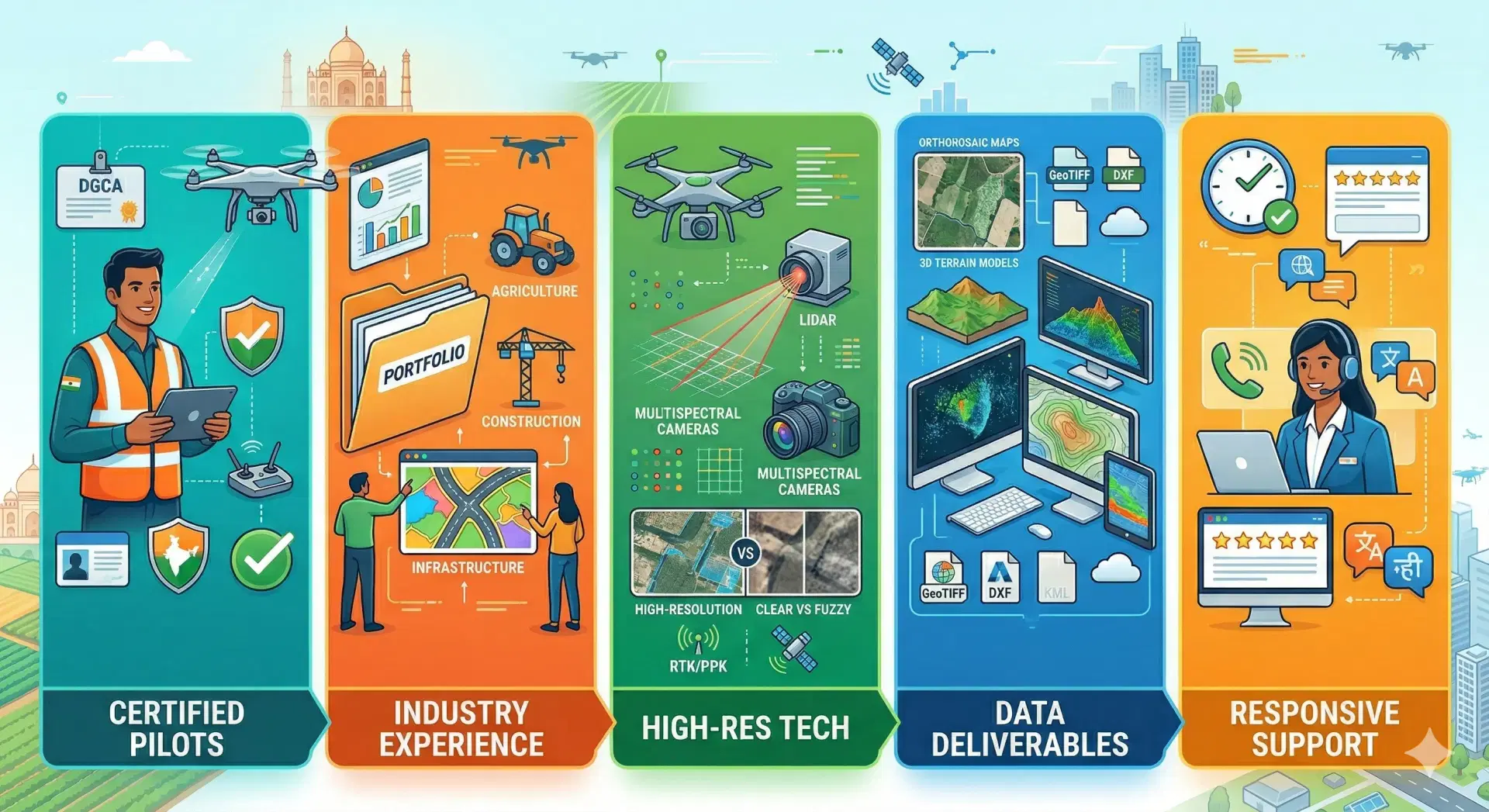
How to Choose a Drone Mapping Provider | Checklist
Practical checklist for choosing a drone mapping service provider. DGCA compliance, accuracy, deliverables, pricing, and red flags to watch for.
How to Choose a Drone Mapping Provider | Checklist
Practical checklist for choosing a drone mapping service provider. DGCA compliance, accuracy, deliverables, pricing, and red flags to watch for.
Table Of Content
- Introduction
- Why Choosing the Wrong Provider Is Costly
- The 9 Criteria That Separate Good Drone Survey Companies from Bad Ones
- 1. DGCA Compliance - Non-Negotiable
- 2. Equipment and Sensor Capability
- 3. Accuracy Methodology and Verification
- 4. Coordinate System and Datum Competence
- 5. Data Processing Capability and Software
- 6. Deliverable Clarity and Format Compatibility
- 7. Sector Experience and Project Portfolio
- 8. Project Management and Communication
- 9. Pricing Transparency and Contract Clarity
- 5 Red Flags That Should End the Conversation
- The Complete Provider Evaluation Checklist
- 14 Questions to Ask Every Provider Before Hiring
- Frequently Asked Questions
- What Good Looks Like
- Conclusion
Introduction
India's drone mapping market has exploded. Following the liberalisation under the Drone Rules 2021, the reduction of GST on drones to a uniform 5% in September 2025, and 38,575 drones now registered on the Digital Sky platform as of February 2026, there is no shortage of providers offering drone mapping services and aerial mapping services across the country. The problem is not finding a drone survey company or drone mapping company - it is finding the right one.
The consequences of choosing the wrong provider are not just inconvenient. They are expensive. Bad drone data leads to rework, incorrect volume calculations, failed government submissions, and in the worst cases, structural decisions made on fundamentally inaccurate terrain models. A 2024 industry study found that poorly executed surveys led to an average 18% rework cost on construction projects. Drone surveys should eliminate that risk - but only when executed by a provider who genuinely knows what they are doing.
This guide gives you a practical, technically grounded framework for evaluating any drone mapping service provider in India - what to ask, what to verify, what to walk away from, and what separates genuinely capable providers from operators who can fly a drone but cannot deliver survey-grade data.
Why Choosing the Wrong Provider Is Costly
Before getting into the selection criteria, it is worth understanding what actually goes wrong when a client hires an underqualified drone mapping company.
Inaccurate data that looks correct. This is the most dangerous failure mode. A visually impressive orthomosaic or 3D model can still be geometrically wrong. As one surveyor with 20 years of experience put it: "You can fly a ₹30,000 RTK drone and still deliver garbage data if you don't understand the process behind it." Manufacturer accuracy specifications come from laboratory conditions - perfect weather, ideal surfaces, zero atmospheric interference. In the real world, errors stack: GNSS position drift, IMU errors, gimbal wobble, sensor calibration offsets, and atmospheric distortion all compound. The result can be data that is off by decimetres or more, with no visual indication that anything is wrong.
Wrong coordinate systems. You can execute a perfect flight, process the imagery correctly, and still deliver data that is useless because the coordinate system does not match the project's existing GIS or CAD data. Data delivered in WGS84 when the project requires a local datum will literally appear on the wrong side of the map when loaded into design software. This is one of the most common and most expensive failures in the Indian drone survey market.
Regulatory exposure for the client. Under the Civil Drone (Promotion and Regulation) Bill 2025, non-compliant drone operations carry criminal penalties of up to three years imprisonment and fines up to ₹1 lakh. If your provider is using non-certified equipment or an uncertified pilot, the legal risk does not rest entirely with them.
Project delays from poor planning. Providers without proper flight planning workflows - correct image overlap parameters, terrain-following altitude adjustments, appropriate weather windows - produce data with gaps, voids, and reconstruction artefacts that require re-flights. On time-sensitive construction or infrastructure projects, this is a direct cost.
Deliverables that cannot be used. A drone survey is only as valuable as its output. Providers who deliver raw imagery or basic orthomosaics when the project required classified point clouds, CAD-compatible DTMs, or volume calculations have wasted your budget entirely.
The 9 Criteria That Separate Good Drone Survey Companies from Bad Ones
1. DGCA Compliance - Non-Negotiable
This is the first filter, and it is binary. Under the Drone Rules 2021 and subsequent amendments, commercial drone operations in India require:
-
DGCA type-certified drone - The aircraft must carry a valid Type Certificate issued by DGCA following evaluation by a QCI-accredited testing entity. Without this, the drone cannot legally hold a Unique Identification Number and cannot operate commercially.
-
Unique Identification Number (UIN) - Every drone above the Nano category must be registered on the Digital Sky platform and issued a UIN, which must be physically marked on the aircraft. Think of it as the Aadhaar of your drone - every flight, operator, and clearance is linked to this traceable identity.
-
Remote Pilot Certificate (RPC) - Pilots must hold a valid DGCA-issued RPC. It is valid for 10 years and is verifiable on the DGCA portal. The old requirement for a traditional pilot licence has been removed, but the RPC is mandatory without exception.
-
Third-party insurance - The Draft Civil Drone Bill 2025 makes this mandatory for all commercial operations, with statutory compensation of ₹2.5 lakh in case of death and ₹1 lakh for grievous hurt. Any provider without insurance is operating outside the emerging legal framework.
-
Airspace compliance - For operations in Yellow Zones near airports, defence installations, or state borders, advance permission via the Digital Sky platform is mandatory. A compliant provider handles this as standard and provides documentation.
What to ask: "Can you share your drone's Type Certificate number and UIN? Can I verify your pilot's RPC number on the DGCA portal?"
Any provider who hesitates, deflects, or cannot immediately provide these details should be eliminated from consideration.
2. Equipment and Sensor Capability
The drone and sensor combination used on your project directly determines the quality and type of data you receive. Do not assume all drone mapping providers use equivalent equipment.
For standard topographic surveys: Look for RTK-enabled photogrammetry platforms such as the DJI Matrice 300 RTK with Zenmuse P1, or the DJI Phantom 4 RTK. These platforms geotag every image with precise GPS coordinates in real time, eliminating the need for dozens of physical Ground Control Points.
For vegetated terrain or corridor surveys: LiDAR capability is essential. Sensors such as the DJI Zenmuse L2 capture 1.2 million points per second with five returns per pulse, enabling ground detection beneath dense foliage. A provider without LiDAR cannot accurately survey forested, hilly, or corridor terrain.
For agriculture or solar inspection: Multispectral or thermal sensor capability is required. These are specialist payloads that not all providers carry or know how to process correctly.
What to ask: "What specific drone model and sensor payload will you use on my project? Do you have RTK capability? Do you own LiDAR equipment, or would you subcontract it?"
The last question matters. Subcontracting is not inherently wrong, but you need to know who is actually executing the survey and verify their credentials independently.
3. Accuracy Methodology and Verification
This is where technically capable providers separate themselves from operators who simply know how to fly.
A provider who claims "1 cm accuracy" without explaining their methodology is making an unverifiable claim. Real survey-grade accuracy requires a verified process, not just a capable drone. The correct methodology involves:
Ground Control Points (GCPs) - Physical targets placed at known coordinates across the site, measured by GNSS or total station. A minimum of 5 GCPs is required for a standard site, plus 1 additional GCP for every 10 acres on larger projects. GCP targets should be high-contrast, 30-60 cm markers with good spatial distribution across the site - not clustered in one area.
Independent check points - Separate from GCPs, these are additional known points used to verify the accuracy of the final model after processing. If the model matches the check points within the target tolerance, the data is verified. If not, something has gone wrong and the provider needs to investigate before delivery.
RMSE reporting - The Root Mean Square Error of the check points must be reported in the accuracy assessment document delivered with the data. Any provider who cannot explain RMSE, or does not include it in their deliverables, is not operating to survey-grade standards.
What to ask: "How do you verify the accuracy of your data? How many GCPs will you establish, and how? Will you provide an accuracy assessment report with RMSE values for independent check points?"
4. Coordinate System and Datum Competence
This is a technical detail that catches out many clients - and many providers. India uses multiple coordinate reference systems depending on the application. Engineering and infrastructure projects typically require data in a local grid or state plane coordinate system. GIS applications may use WGS84 or a specific Indian datum.
If your provider delivers data in the wrong coordinate system, it will not align with your existing plans, CAD drawings, or GIS layers - even if the internal accuracy of the drone data is perfect. There are documented cases where drone models have loaded into CAD software appearing on the wrong side of the street entirely, because the vertical datum was handled incorrectly.
A competent provider will ask about your coordinate system requirements before the survey, confirm the datum and projection, and ensure all deliverables - flight logs, GCPs, processed outputs, and CAD files - are consistent in that system.
What to ask: "What coordinate system will my deliverables be in? Can you match our existing project datum? How do you handle datum transformations if required?"
If the provider looks blank at this question, that is your answer.
5. Data Processing Capability and Software
Drone data collection is only half the job. The quality of the final deliverables depends entirely on the processing workflow - the software used, the processing parameters set, and the expertise of the person running it.
Leading providers use professional photogrammetry software such as Pix4D, Agisoft Metashape, or DJI Terra for photogrammetry processing. These are not cheap tools - Pix4D alone costs approximately $350/month - and they require significant computing hardware and trained operators to use correctly.
A structured QA/QC pipeline before delivery should include:
- Checking image sharpness and exposure uniformity across the dataset
- Validating GNSS positioning quality (RTK fix percentage)
- Running rapid low-resolution processing to detect capture errors before full processing
- Inspecting point clouds and surfaces for noise, voids, or artefacts
- Maintaining redundant backups of raw data
Warning signs that a provider is cutting corners on processing: they cannot name the software they use; they promise unusually fast turnaround (less than 24 hours for large sites); they cannot explain what GSD (Ground Sample Distance) means or how it relates to your deliverable resolution.
What to ask: "What software do you use for processing? What GSD will my orthomosaic be at? How long will processing take, and what does your QA/QC process look like before delivery?"
6. Deliverable Clarity and Format Compatibility
Two providers can quote for the same "drone survey" and deliver entirely different outputs. Before accepting any quote, establish precisely what files you will receive and verify they are compatible with your downstream software.
| Deliverable | Format | Typical Use |
|---|---|---|
| Orthomosaic | GeoTIFF | Visual reference, area measurement |
| Digital Terrain Model (DTM) | GeoTIFF, ASCII | Engineering design, contour generation |
| Digital Surface Model (DSM) | GeoTIFF | Above-ground features, building heights |
| Contour lines | DXF, SHP | Civil engineering, planning submissions |
| 3D Point Cloud | LAS / LAZ | BIM, volumetric analysis, structural engineering |
| Volume calculations | PDF report, CSV | Mining, earthworks, stockpile management |
| Accuracy assessment report | Verification, client sign-off, government submission |
What to ask: "What exact file formats will I receive? Are CAD outputs in DXF or DWG? Is the point cloud classified or raw? Is an accuracy assessment report included as standard, or is it an extra?"
7. Sector Experience and Project Portfolio
Drone mapping for a mining stockpile volume calculation requires a fundamentally different workflow than a corridor LiDAR survey for a railway project, which is different again from a multispectral agricultural survey. A provider with deep experience in your specific sector will understand the accuracy requirements, the deliverable formats your downstream teams need, and the site-specific challenges that generic operators will not anticipate.
Ask to see a portfolio of completed projects in your sector. Specifically:
- Case studies with measurable outcomes - not just pretty pictures
- Examples of accuracy assessment reports from similar projects
- References from clients in your industry who can speak to data quality and project management, not just turnaround time
When evaluating drone mapping companies, look beyond their website portfolio. At Aeroyantra, every project proposal includes a methodology document specific to the site type and sector - whether that is a construction topographic survey, a mining volume programme, or an infrastructure corridor - so clients understand exactly what they are commissioning before any flight takes place. That level of pre-project clarity is what distinguishes a professional aerial mapping services provider from an operator who simply shows up with a drone. Drone survey services that cannot demonstrate sector experience are a risk.
What to ask: "Can you share two or three case studies from projects similar to mine? Can I speak with a reference client in my sector?"
8. Project Management and Communication
The technical capability of a drone mapping provider means nothing if their project management is poor. Late flights, missed deliverable deadlines, and unresponsive communication are common complaints in the Indian market - particularly with smaller operators managing multiple projects simultaneously.
Evaluate the following before committing:
-
Pre-survey consultation - Does the provider offer a consultation to understand your specific requirements, terrain, and access constraints before quoting? Or do they send a price based on area size alone?
-
Weather contingency policy - What happens if the survey day is disrupted by rain, wind, or poor visibility? Is a re-flight included or charged separately?
-
Communication during processing - Will you receive updates during the processing phase, or will you simply wait for a delivery email with no visibility on progress?
-
Data delivery and retention - Is data delivered via a cloud platform with download access, or via hard drive? What is the retention policy for your raw data if you need it later?
-
Re-flight policy - If the delivered data has quality issues identified during your own review, what is the provider's process for addressing them?
What to ask: "What is your weather contingency policy? What happens if you identify a data quality issue during processing? How do you communicate with clients between flight day and delivery?"
9. Pricing Transparency and Contract Clarity
Drone survey pricing in India varies significantly - not just between providers, but within quotes from the same provider depending on how the scope is defined. The most common source of disputes is ambiguity about what is included.
A transparent provider will give you a quote that itemises:
- Survey area and pricing model (lump sum or per acre)
- Mobilisation costs, separately stated
- Sensor and platform to be used
- Accuracy specification and methodology
- Deliverables list with file formats
- Processing and delivery timeline
- GST (5%) - included or excluded
- Re-flight policy and associated costs
Be cautious of quotes significantly below market rates. In the Indian drone survey market in 2026, photogrammetry surveys for sites over 100 acres are typically priced at ₹350-₹500/acre, and LiDAR surveys at ₹1,500-₹4,600/acre depending on scale. A quote dramatically below these ranges either excludes key deliverables, uses non-certified equipment, or involves a provider who will cut corners on methodology. As the saying goes in this industry: poor costing is bad for the project and bad for the business.
What to ask: "Is GST included? Are mobilisation costs itemised separately? What happens to the price if the site requires more GCPs than planned? Is the accuracy assessment report included or charged extra?"
5 Red Flags That Should End the Conversation
These warning signs should cause you to immediately stop engaging with a provider:
1. Cannot provide Type Certificate or UIN documentation. If they cannot verify DGCA compliance on request, walk away. The legal risk under the Civil Drone Bill 2025 is not worth any cost saving.
2. Claims "1 cm accuracy" without explaining how they will achieve and verify it. Accuracy is a process, not a specification. Any provider who cannot explain their GCP methodology, check point verification, and RMSE reporting is not delivering survey-grade data - regardless of what the drone's spec sheet says.
3. Does not ask about your coordinate system requirements. A provider who does not raise this before the survey does not understand the full workflow. Your data may be geometrically perfect and still completely unusable.
4. Quotes without specifying the drone model and sensor. If they will not commit to the equipment before you pay, they may substitute cheaper or non-certified hardware on the day.
5. No written scope document or contract. Verbal agreements on deliverables, timelines, and re-flight policies always end in disputes. Insist on a written scope before any payment is made.
The Complete Provider Evaluation Checklist
Use this before committing to any drone mapping company in India:
Regulatory compliance:
- DGCA type-certified drone - Type Certificate number provided and verifiable
- Pilot holds valid Remote Pilot Certificate - verifiable on DGCA portal
- Drone registered on Digital Sky with UIN physically marked on aircraft
- Third-party insurance in place
- Airspace permissions handled for your specific site and zone
Technical capability:
- RTK-enabled platform or GCP-based methodology confirmed
- Sensor payload specified and appropriate for your application
- LiDAR available if required by terrain or application
- Processing software named - Pix4D, Metashape, DJI Terra, or equivalent
- Coordinate system and datum requirements discussed and confirmed before survey
Deliverables:
- Full deliverable list specified in writing with file formats confirmed
- GSD (orthomosaic resolution in cm/pixel) specified
- Point cloud classification status confirmed if LAS/LAZ required
- Accuracy assessment report with RMSE values included as standard
- Volume calculations or contour lines included if required
Project management:
- Pre-survey consultation conducted
- Weather contingency policy in writing
- Processing and delivery timeline committed in the contract
- Re-flight policy documented
- Data delivery method and raw data retention policy confirmed
Pricing:
- GST treatment confirmed - included or excluded
- Mobilisation costs itemised separately
- Full scope of work in writing before any payment
- Additional GCP and re-flight costs clarified upfront
14 Questions to Ask Every Provider Before Hiring
Use this list in every provider conversation - in person, over email, or on a call:
- What is your drone's Type Certificate number and UIN?
- What is your pilot's Remote Pilot Certificate number?
- What specific drone model and sensor payload will you use on my project?
- Is your survey RTK-enabled, or will you establish physical GCPs?
- How many GCPs will you set, and using what measurement method?
- How do you verify accuracy - what check points and RMSE reporting do you provide?
- What coordinate system and datum will my deliverables be in?
- What processing software do you use?
- What exact files will I receive, and in what formats?
- What is your image overlap specification for this project?
- What is your weather contingency and re-flight policy?
- Is GST included in your quote, and are mobilisation costs itemised separately?
- Can you share two case studies from projects similar to mine?
- Can I speak with a reference client in my sector?
Frequently Asked Questions
How do I verify a drone pilot's Remote Pilot Certificate in India?
Remote Pilot Certificates are issued by DGCA and verifiable on the eGCA portal. Ask the provider for their pilot's RPC number and check it yourself before signing any contract. A legitimate provider will have no hesitation sharing this.
Is it legal to hire a drone survey company that uses non-DGCA-certified drones?
Commissioning a survey from a non-compliant operator puts you at legal risk, not just the operator. Under the Civil Drone Bill 2025, penalties include criminal imprisonment of up to three years. Always verify compliance before committing.
What is the difference between RTK and GCP-based drone surveys?
RTK (Real-Time Kinematic) uses a GPS correction signal to geotag every image with precise coordinates in real time, reducing or eliminating the need for physical GCPs. GCP-based surveys use physical ground markers at known coordinates to georeference the model after processing. Both methods can achieve 1-3 cm accuracy when executed correctly. RTK is faster in the field; GCP-based surveys require more field time but can be more reliable in areas with poor GNSS signal.
What should a drone survey deliverable package include as standard?
At minimum: a georeferenced orthomosaic, a Digital Terrain Model, contour lines at the specified interval, and an accuracy assessment report with RMSE values from independent check points. For engineering applications, a classified point cloud in LAS/LAZ format should also be standard.
How long does it take to receive drone survey deliverables?
Field data collection for most sites takes one day or less. Processing and delivery typically takes 2-7 working days depending on site size and deliverable complexity. A provider who promises same-day or next-day delivery for large, complex sites is almost certainly cutting corners on processing and QA/QC.
Why do drone survey quotes vary so much in India?
Because "drone survey" is not a standardised service. Quotes vary based on the drone and sensor used, the accuracy methodology, the number of GCPs established, the processing software, and the deliverables included. Always compare what is actually in the scope, not just the headline price. A ₹300/acre quote that includes only an orthomosaic is not comparable to a ₹500/acre quote that includes an orthomosaic, DTM, classified point cloud, contours, and an accuracy report.
What Good Looks Like
Choosing a drone mapping services provider in India is ultimately a decision about trust - trust that the data you receive is accurate, the compliance is genuine, and the deliverables will actually serve your project's needs.
The standard you should expect from any professional drone survey company in India in 2026:
- DGCA type-certified equipment and DGCA-licensed pilots as a baseline, not a premium
- A written methodology document before any flight takes place
- A clear GCP plan with independent check point verification
- Coordinate system confirmed and matched to your project before fieldwork begins
- A full accuracy assessment report with RMSE values delivered with every dataset
- An itemised quote with GST, mobilisation, deliverables, and re-flight policy all in writing
Aeroyantra operates to exactly this standard on every project - photogrammetry, LiDAR, thermal, and corridor surveys across India. Every engagement begins with a methodology document, every dataset is delivered with a verified accuracy report, and every quote is fully itemised before any payment is required. That is not a premium offering. It is what professional aerial mapping services should look like.
Conclusion
India's drone mapping industry is growing rapidly, but the market is uneven. Alongside genuinely capable, compliant providers, there are operators who produce visually impressive outputs that fail the moment they are subjected to engineering scrutiny or regulatory review.
The framework in this guide gives you the tools to tell the difference. Verify DGCA compliance before anything else. Demand a clear accuracy methodology with RMSE reporting. Confirm your coordinate system requirements upfront. Specify your deliverables in writing. And walk away from any provider who cannot answer the questions in the checklist above with confidence and documentation.
The right drone survey company does not just fly a drone over your site. They deliver data you can make decisions with, submit to government authorities, hand to your engineering team, and defend if challenged. In 2026, that standard is achievable across India - but only if you know how to ask for it.
About the Author
This guide was prepared by the survey technology team at Aeroyantra, a DGCA-certified drone mapping company providing photogrammetry, LiDAR, and aerial mapping services across India for construction, infrastructure, mining, and agriculture clients.
Don't have a drone team?
Our DGCA-certified pilots survey your project site and deliver results in 48 hours - no equipment, no software required.
Last updated: April 2026. Questions about choosing a drone mapping provider for your project? Contact our team - we respond within one business day.
Related Articles
Explore more insights and stories from our blog
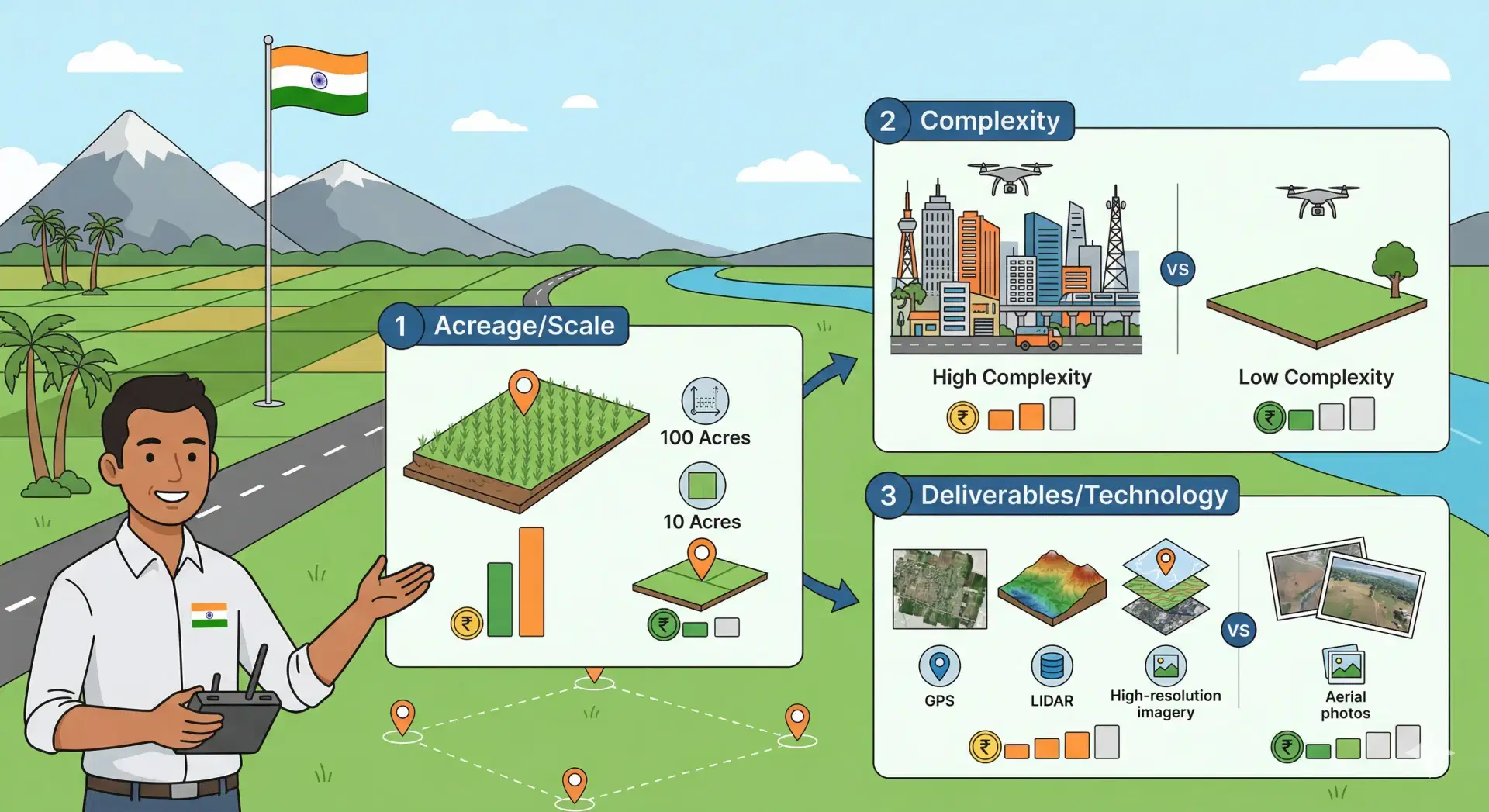
Drone Survey Cost in India 2026 | Per Acre Pricing
Drone survey cost in India for 2026. Per acre pricing breakdown by project type, deliverables, area size, and accuracy level. Compare service providers.
![Agisoft Metashape vs Aeroyantra: Honest Pricing & Feature Comparison [2026]](/_next/image?url=https%3A%2F%2Fdh2si8yscu98g.cloudfront.net%2Fimages%2Fblogs%2Fagisoftmetashape-vs-aeroyantra.webp&w=1920&q=75)
Agisoft Metashape vs Aeroyantra: Honest Pricing & Feature Comparison [2026]
Metashape Professional is $3,499 one-time. Aeroyantra is $0 pay-per-use or $69/month. Honest comparison: desktop photogrammetry vs cloud survey platform. Hardware costs, features, accuracy for 2026.
![DroneDeploy vs Aeroyantra: Honest Pricing & Feature Comparison [2026]](/_next/image?url=https%3A%2F%2Fdh2si8yscu98g.cloudfront.net%2Fimages%2Fblogs%2Fdronedeploy%20vs%20aeroyantra.webp&w=1920&q=75)
DroneDeploy vs Aeroyantra: Honest Pricing & Feature Comparison [2026]
DroneDeploy costs $329-$499/seat/month. Aeroyantra is pay-per-use at $2.50/credit with no seat fees. Side-by-side comparison of pricing, features, and accuracy for 2026.