
Drone Survey Cost in India 2026 | Per Acre Pricing
Drone survey cost in India for 2026. Per acre pricing breakdown by project type, deliverables, area size, and accuracy level. Compare service providers.
Drone Survey Cost in India 2026 | Per Acre Pricing
Drone survey cost in India for 2026. Per acre pricing breakdown by project type, deliverables, area size, and accuracy level. Compare service providers.
Table Of Content
- What You'll Learn
- Introduction
- What Does a Drone Survey in India Actually Cost?
- 8 Factors That Determine Your Drone Survey Cost in India
- Aerial Survey vs Traditional Ground Survey: Cost Comparison in India
- Sector-by-Sector Pricing in India
- Pricing by Client Segment: Why Quotes Vary So Much
- LiDAR vs Photogrammetry: Which Should You Pay For?
- What Is the Civil Drone Bill 2025 and How Does It Affect Survey Costs?
- What Is Driving Drone Survey Costs Down in India?
- How to Evaluate a Drone Survey Company Quote: A Practical Checklist
- Tips for Getting the Best Value from Your Drone Survey Budget
- The Hidden Cost: Data Processing and Why SaaS Changes the Equation
- Frequently Asked Questions
- Summary: Drone Survey Pricing at a Glance - India 2026
- Conclusion
What You'll Learn
Real, verified pricing data from the Indian drone survey market in 2026, covering photogrammetry and LiDAR rates, the eight factors that determine your final cost, sector-by-sector pricing breakdowns, and a practical checklist to evaluate any quote with confidence.
Introduction
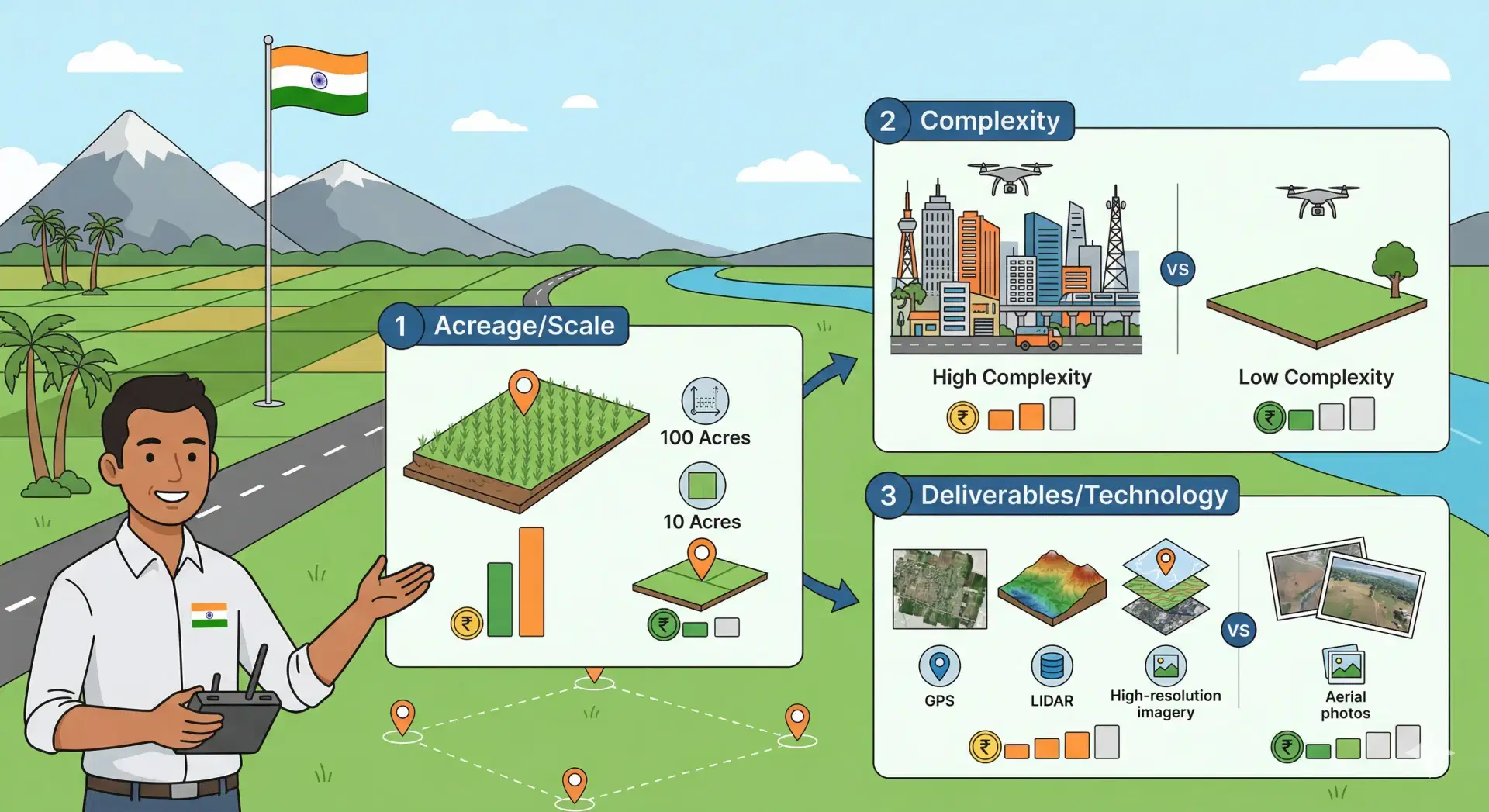
If you have ever tried to get a straight answer on drone survey pricing in India, you already know the challenge. Ask three service providers and you will receive three wildly different numbers - sometimes varying by 10x for what appears to be the same job. That is not a sign of a broken market. It reflects the genuine complexity of factors that determine what a drone survey actually costs: the size of the site, the terrain, the sensor technology, the accuracy required, and the deliverables you need at the end.
India's drone surveying industry has undergone a fundamental transformation in the past three years. Regulatory reforms under the Drone Rules 2021, and amendments in 2022 and 2023, have simplified compliance dramatically - approval requirements were reduced from 72 down to just 4, and nearly 90% of Indian airspace was declared a Green Zone for drone operations. In September 2025, GST on drone hardware purchases was reduced to 5%, while drone survey services continue to be charged 18% GST. As of February 2026, 38,575 drones have been registered and issued Unique Identification Numbers on the Digital Sky platform - a clear signal of how rapidly the industry is scaling.
These changes have significantly lowered the cost of running a drone survey business in India, and those savings are flowing through to project pricing. This guide gives you real, verified pricing data from the Indian market in 2026, explains every factor that moves the cost up or down, and helps you evaluate any quote you receive with confidence.
What Does a Drone Survey in India Actually Cost?
Drone survey pricing in India follows two models depending on project scale: lump-sum pricing for smaller sites, and per-acre rates for larger projects. Whether you need drone survey services for a topographical survey, GIS mapping, or a full aerial survey, these rates apply. Below are real market rates sourced from active Indian survey providers in 2025-2026.
Photogrammetry Drone Survey - Topographic and Contour Mapping
This is the most common type of drone survey in India, used for land records, construction planning, infrastructure projects, and real estate development.
| Area Size | Survey Cost (INR) | Mobilisation (Near Major Metro) | Pricing Model |
|---|---|---|---|
| Up to 1 acre | ₹35,000 | ₹5,000 | Lump sum |
| 1 - 10 acres | ₹55,000 | ₹5,000 | Lump sum |
| 10 - 50 acres | ₹75,000 | ₹5,000 | Lump sum |
| 50 - 100 acres | ₹95,000 | ₹5,000 | Lump sum |
| 100 - 500 acres | ₹400/acre | ₹5,000 | Per acre |
| 500 acres and above | ₹300/acre | ₹5,000 | Per acre |
Source: Active Indian survey providers, 2025. Mobilisation rates apply near Mumbai, Delhi, Kolkata, and Udaipur. Remote locations carry higher mobilisation charges.
A note on market pricing: These rates reflect the structured, DGCA-compliant segment of the market. Non-compliant or informal operators may quote 30-50% lower, but they carry significant legal, quality, and project risks. Government tender rates at scale can also be substantially lower due to volume-based pricing. When comparing quotes, always verify DGCA compliance, equipment certification, and deliverable quality before selecting on price alone.
LiDAR Drone Survey - Topographic, DTM, DSM, Point Cloud
LiDAR surveys are required for vegetated terrain, corridor mapping, and applications where photogrammetry cannot penetrate canopy. Pricing is higher due to sensor cost and processing complexity.
| Area Size | Survey Cost (INR) | Mobilisation | Pricing Model |
|---|---|---|---|
| Up to 1 acre | ₹35,000 | ₹10,000 | Lump sum |
| 1 - 10 acres | ₹55,000 | ₹10,000 | Lump sum |
| 10 - 50 acres | ₹75,000 | ₹10,000 | Lump sum |
| 50 - 100 acres | ₹95,000 | ₹10,000 | Lump sum |
| 100 - 500 acres | ₹4,600/acre | ₹10,000 | Per acre |
| 500 - 1,000 acres | ₹2,500/acre | ₹10,000 | Per acre |
| 1,000 - 1,500 acres | ₹2,000/acre | ₹10,000 | Per acre |
| 1,500 acres and above | ₹1,500/acre | ₹10,000 | Per acre |
Source: Active Indian survey providers, 2025. Deliverables include topographic map, DTM, DSM, orthoimage, point cloud, contours, and spot levels.
LiDAR Pricing by Sensor Tier
Not all LiDAR surveys are equal. The sensor used directly affects data quality, point density, and cost. Here is how pricing breaks down by LiDAR tier in India:
| LiDAR Tier | Example Sensor | Cost Per Acre (INR) | Best For |
|---|---|---|---|
| Entry-level | DJI Zenmuse L1 | ₹3,000 - ₹4,000 | General topography, basic corridor scans |
| Mid-range | DJI Zenmuse L2 | ₹4,000 - ₹6,000 | Vegetation penetration, engineering-grade surveys |
| Enterprise-grade | RIEGL, Hesai, YellowScan | ₹7,000+ | High-density forestry, power line classification, railway corridors |
When requesting a LiDAR quote, always ask which sensor will be used and the expected point density (points per square metre). An L1 survey at 100 pts/sqm and a RIEGL survey at 500+ pts/sqm are fundamentally different products at fundamentally different price points.
Drone Mapping Services Pricing by Survey Type - Per Acre Rates (India 2026)
| Survey Type | Cost Per Acre (INR) | Typical Use Case |
|---|---|---|
| Basic 2D Aerial Mapping | ₹500 - ₹1,500 | Land records, area measurement, GIS mapping |
| High-Resolution Topographic Survey | ₹1,200 - ₹3,000 | Topographical survey for construction, infrastructure |
| Drone Land Survey (3D Modelling & Volumetrics) | ₹1,500 - ₹4,500 | Mining, earthworks, stockpiles |
| LiDAR Survey | ₹5,000 - ₹10,000 | Forestry, utility corridors, dense terrain |
| Thermal / Multispectral Survey | ₹3,000 - ₹8,000 | Agriculture, solar farm inspection |
| Corridor Aerial Survey | ₹8,000 - ₹25,000/km | Roads, pipelines, railways |
| Construction Progress Monitoring | ₹25,000 - ₹60,000/visit | Monthly site progress |
All prices are indicative for 2026. Add 18% GST on services unless quoted as inclusive. Actual quotes will vary by terrain, accuracy requirements, and provider.
8 Factors That Determine Your Drone Survey Cost in India
Understanding these factors gives you the knowledge to evaluate any quote intelligently and negotiate from a position of clarity.
1. Survey Area and Scale
Area size is the single biggest driver of per-unit cost. Larger sites benefit from economies of scale - mobilisation, flight planning, and GCP establishment are largely fixed costs regardless of whether you are surveying 50 acres or 500 acres. This is why per-acre rates drop sharply at scale.
For budgeting purposes: sites under 50 acres are typically priced as lump sums. Above 100 acres, always negotiate per-acre rates and ask about volume discounts for repeat survey programmes.
2. Terrain Complexity
Flat agricultural land, open construction sites, and regular urban plots are the easiest and cheapest to survey. Hilly terrain, dense forests, coastal areas, and sites with significant elevation variation require more Ground Control Points (GCPs), additional flight passes, and more complex post-processing - all of which add to the final cost.
A survey of 100 acres of flat farmland in Punjab may cost 30-40% less than the same area of undulating terrain in the Western Ghats or Himalayan foothills, even with the same provider. Always disclose terrain type when requesting a quote.
3. Sensor and Payload Type
The camera or sensor mounted on the drone has a major impact on pricing:
- RGB photogrammetry cameras - Standard option, lowest cost, suitable for topographic mapping, orthomosaics, and 3D models on open terrain.
- Multispectral sensors - Used for precision agriculture and vegetation health mapping. Moderate premium over standard RGB.
- Thermal cameras - Required for solar panel inspection, building energy audits, and industrial inspections. Significant premium due to sensor cost and specialist processing.
- LiDAR sensors - The highest-cost option. LiDAR is essential for surveys under tree canopy, corridor mapping through vegetation, and high-precision terrain modelling. The DJI Zenmuse L2, for example, captures 1.2 million points per second with five returns per pulse, enabling ground detection beneath dense foliage. Expect to pay 3-5x the photogrammetry rate for LiDAR work.
4. Required Accuracy and Ground Control
Standard drone photogrammetry without RTK or GCPs achieves 10-30 cm accuracy - adequate for general mapping but not for engineering or legal applications.
Survey-grade accuracy of 1-5 cm requires either:
- RTK (Real-Time Kinematic) drone - Built-in GPS correction that geotags every image with precise coordinates in real time. Reduces or eliminates the need for physical GCPs.
- GCPs established by GNSS or total station - Physical markers placed at known coordinates across the site. Adds field time and cost but achieves the same accuracy.
If your project requires accuracy certification for government submission, infrastructure tendering, or legal documentation, always specify RTK or GCP-based survey. The premium is typically 20-40% over standard photogrammetry rates.
5. Deliverable Requirements
What you need at the end of the survey significantly affects cost. Specify your deliverables in writing before accepting any quote:
- Orthomosaic map only - Basic deliverable, lowest processing cost
- Digital Terrain Model (DTM) / Digital Surface Model (DSM) - Standard engineering deliverable
- Contour lines at 0.5m or 1m intervals - Additional processing step
- 3D point cloud in LAS/LAZ format - Required for BIM integration and volumetric analysis
- Volume calculations for stockpiles or cut-fill - High-value deliverable, adds processing time
- Full CAD-compatible output - Highest processing cost, required for detailed engineering design
Two quotes for a "drone survey" may include entirely different outputs. Always compare deliverables, not just headline prices.
6. DGCA Compliance and Regulatory Costs
Under the Drone Rules 2021 and amendments, commercial drone operations in India require:
- DGCA type-certified drones - Equipment must carry valid type certification issued by DGCA.
- Remote Pilot Certificate (RPC) - Pilots must hold a valid DGCA-issued RPC. The old requirement for a traditional pilot licence has been removed.
- Flight plan submission via Digital Sky / eGCA - Required for operations outside Green Zones. Near airports, defence installations, or state borders, advance permissions are mandatory.
- Third-party insurance - The Draft Civil Drone (Promotion and Regulation) Bill 2025 makes this mandatory for all commercial operations, adding to operator overheads.
Reputable providers include DGCA compliance costs in their quoted rates. If a provider quotes unusually low prices, verify that they are using type-certified equipment and hold valid certifications. Non-compliant operations expose clients to legal and project risk.
7. Post-Processing and Software
Raw drone data is not a deliverable. Processing overlapping images into an orthomosaic, generating a point cloud, or calculating volumes requires specialist software such as Pix4D, Agisoft Metashape, or DJI Terra. More complex deliverables require more processing time and expertise, which is reflected in the final cost.
For standard topographic surveys, processing typically takes 1-3 days. For large-area LiDAR projects with full classification and CAD output, processing may take 5-10 days. Always confirm the expected delivery timeline in your quote.
8. Mobilisation and Logistics
For sites more than 100-150 km from a major city, expect significant mobilisation charges covering travel (air or road), equipment transport, accommodation for the survey crew, and local permit acquisition.
Remote sites in states such as Arunachal Pradesh, Ladakh, Sikkim, or the Andaman Islands carry substantially higher mobilisation costs than comparable surveys in Haryana, Maharashtra, or Tamil Nadu. Always request mobilisation costs as a separate line item in your quote so you can compare providers fairly.
Aerial Survey vs Traditional Ground Survey: Cost Comparison in India
For project managers evaluating whether to commission a drone survey or a conventional ground survey, the financial comparison is compelling.
| Parameter | Traditional Survey (per 100 acres) | Drone Survey (per 100 acres) |
|---|---|---|
| Cost | ₹1,50,000 - ₹2,50,000 | ₹40,000 - ₹80,000 |
| Time Required | 7-10 days | 1 day |
| Accuracy | 5-10 cm | 1-3 cm (RTK) |
| Manpower | 4-6 surveyors | 1 pilot + 1 assistant |
| Data Density | Hundreds of points | Millions of points |
| Safety Risk | High (field exposure) | Very low |
The cost saving typically ranges from 30-70% in favour of drone surveys depending on project complexity, terrain, GCP requirements, and deliverable scope. For straightforward open-terrain sites over 10 acres, savings regularly exceed 50%. For complex terrain with dense GCP requirements and advanced deliverables, savings are closer to 30-40%. On large-scale programmes - for example, surveying ten 120-acre sites five times per year - the annual saving can exceed ₹80-90 lakh compared to traditional methods.
Beyond direct cost, drone surveys reduce rework costs by 15-25% due to their far greater data density. Traditional surveys involve substantial interpolation between measured points, introducing quantity variance errors of 5% or more on earthworks projects. Drone surveys, with millions of data points, reduce this variance to 1-3% - a saving of ₹20-40 lakh per year on large road or mining programmes.
Sector-by-Sector Pricing in India
Drone survey pricing varies significantly by application sector. Here is what to expect across the major verticals.
Construction and Real Estate
Topographic surveys for building planning and infrastructure design are the most common application. Standard rates range from ₹1,200-₹3,000 per acre for photogrammetry with DTM and orthomosaic deliverables. The National Highways Authority of India (NHAI) now mandates monthly drone video recordings for all highway projects, which has driven standardisation of corridor survey pricing. Construction progress monitoring visits are typically priced at ₹25,000-₹60,000 per visit depending on site size.
Mining and Quarrying
Volume calculation surveys for stockpile management and cut-fill tracking are high-value applications with a strong ROI. Pricing typically ranges from ₹1,500-₹4,500 per acre for 3D modelling with volumetric output. Repeat surveys - weekly or monthly - attract volume discounts of 20-30% from most providers. Mining companies that switch to drone-based volume tracking routinely reduce quantity variance from 5% to under 2%, translating to significant savings on earthworks billing.
Agriculture
Multispectral surveys for crop health monitoring, precision farming, and irrigation planning cost ₹1,500-₹4,000 per acre depending on sensor type and analysis depth. The Indian government offers subsidies of up to ₹5 lakh for eligible farmers, agricultural graduates, and FPOs adopting drone technology, which can significantly offset survey costs for qualifying projects. Drones can survey up to 1,000 acres in a single day, a task that would take a field scout significantly longer.
Infrastructure Corridors - Roads, Railways, Pipelines
Linear corridor surveys are priced per kilometre rather than per acre, reflecting the mobilisation and logistics involved in moving equipment along extended routes. Expect ₹8,000-₹25,000 per km depending on corridor width, terrain complexity, and accuracy requirements. LiDAR is often specified for railway and pipeline corridors where vegetation penetration is required to detect ground level accurately.
Solar and Energy Infrastructure
Thermal drone surveys for solar panel fault detection are transforming operations and maintenance economics across India's rapidly growing solar sector. Survey costs of ₹3,000-₹8,000 per acre are offset by dramatic improvements in fault detection accuracy - from approximately 60% with manual inspection to over 95% with thermal drones - and reductions in inspection time from 20-25 days to just 2 days. The ROI on thermal drone inspection programmes is among the highest of any drone application.
Land Records and Revenue Surveys
Several Indian states are deploying drone surveys for land parcel mapping under the SVAMITVA scheme and state-level land digitisation programmes. As of March 2025, 31 states and Union Territories have signed Memorandums of Understanding for drone-based land surveys. Government-contracted rates for basic 2D mapping at scale are typically ₹200-₹500 per acre, reflecting the volume and programme-level discounts negotiated at state level.
Urban Planning and Smart Cities
3D city modelling, infrastructure mapping, and smart city planning surveys use a combination of photogrammetry and LiDAR. These projects are typically scoped and priced as fixed-cost contracts rather than per-acre rates, given the complexity of urban environments and the multiple flight passes required to capture building facades and street-level features.
Pricing by Client Segment: Why Quotes Vary So Much
One reason drone survey pricing in India can seem inconsistent is that different client segments operate in entirely different pricing environments. Understanding which segment your project falls into helps you interpret the quotes you receive.
Government and Public Sector Tenders
Government-contracted surveys, including SVAMITVA land mapping, NHAI corridor surveys, and state-level revenue digitisation projects, are priced at the lowest end of the market. Rates of ₹120-₹300 per acre for photogrammetry are common at scale, driven by large volumes, multi-year contracts, and competitive L1 (lowest bidder) procurement processes. These rates are not realistic benchmarks for private-sector projects with smaller scope and higher deliverable expectations.
EPC Contractors and Infrastructure Companies
EPC firms working on highways, railways, pipelines, and industrial projects typically pay mid-market rates. Photogrammetry surveys range from ₹300-₹500 per acre, and LiDAR surveys from ₹2,000-₹5,000 per acre depending on corridor complexity. These clients value DGCA compliance, engineering-grade accuracy, and reliable delivery timelines. Repeat survey programmes across project lifecycles attract volume discounts of 20-30%.
Private Developers and Landowners
Private real estate developers, mining companies, and individual landowners typically pay the highest per-acre rates because their projects are smaller in scope and often require faster turnaround. Expect to pay ₹400-₹600 per acre for photogrammetry and ₹4,000-₹7,000 per acre for LiDAR on projects under 200 acres. The premium reflects mobilisation costs spread over fewer acres and the higher per-unit cost of processing smaller datasets.
Enterprise and SaaS-Enabled Workflows
Organisations that integrate drone survey data into digital workflows - BIM platforms, GIS dashboards, or cloud-based processing pipelines - represent the premium segment. These clients pay for accuracy, format compatibility, API-ready outputs, and ongoing data management. Survey costs are higher, but the total cost of ownership is often lower because automated processing replaces manual data handling and reduces turnaround from weeks to days.
When comparing quotes, make sure you are comparing within the same client segment. A government tender rate is not a valid benchmark for a private developer project, and vice versa.
LiDAR vs Photogrammetry: Which Should You Pay For?
This is one of the most common questions buyers ask, and the answer has a direct impact on your budget.
Choose photogrammetry when:
- Your site is open, flat, or lightly vegetated
- You need orthomosaics, basic contours, and standard DTMs
- Your accuracy requirement is 3-10 cm
- Budget is a primary constraint
Choose LiDAR when:
- Your site has dense vegetation or tree canopy
- You need ground-level terrain data beneath foliage
- You are surveying a linear corridor (road, railway, pipeline)
- You need classified point clouds for BIM or engineering design
- Your accuracy requirement is 1-3 cm on complex terrain
The cost premium for LiDAR over photogrammetry in India is approximately 5-10x per acre for smaller sites, narrowing to 3-5x at scale. For most open-terrain construction and land record applications, photogrammetry delivers sufficient accuracy at a fraction of the LiDAR cost. For forested, hilly, or corridor applications, LiDAR is not optional - it is the only method that reliably captures the ground.
What Is the Civil Drone Bill 2025 and How Does It Affect Survey Costs?
The Draft Civil Drone (Promotion and Regulation) Bill 2025, circulated for public comment in September 2025, introduces several changes directly relevant to survey project budgets.
Mandatory third-party insurance. The Bill requires all drone operations to be covered by third-party insurance, with statutory compensation of ₹2.5 lakh in case of death and ₹1 lakh in case of grievous hurt. This adds a compliance cost for operators that will be reflected in service pricing.
Stricter type certification. The Bill extends type certification requirements to manufacturers as well as operators, and ties certification directly to safety and security compliance. This raises the baseline quality of the market but may push out the lowest-cost, non-certified operators.
Government authority to regulate tariffs. Section 45 of the Bill authorises the government to regulate the economic terms of drone services - fares, fees, tariffs, and charges. This is a significant potential development that could introduce regulated pricing floors or caps, though no such regulation has been enacted as of April 2026.
Criminal penalties. The Bill introduces criminal penalties of up to three years imprisonment and fines of up to ₹1 lakh for serious violations. This significantly increases the importance of working with fully compliant, certified providers. Police are also empowered to seize drones and related equipment in case of violations.
The practical implication for buyers: quotes from fully compliant, insured operators with certified equipment may be slightly higher than informal operators, but the legal and project risk of using non-compliant providers is substantial and growing under the new framework.
What Is Driving Drone Survey Costs Down in India?
Several structural forces are making drone surveys progressively more affordable:
Regulatory liberalisation. The Drone Rules 2021 and subsequent amendments reduced compliance requirements from 72 approvals to just 4, dramatically lowering operational overhead. This has encouraged more providers to enter the market, increasing competition and pushing prices down across all survey types.
GST reduction on hardware. The reduction of GST on drone hardware purchases to 5% in September 2025 - down from earlier rates of 18-28% - has directly reduced equipment costs for operators. This reform also applies to flight and motion simulators used for drone pilot training, lowering skill development costs. Drone survey services continue to be charged 18% GST.
PLI scheme for domestic manufacturing. The Production Linked Incentive scheme with an approved outlay of ₹120 crore is encouraging domestic drone manufacturing. As more Indian-made platforms become available, import-dependent equipment costs will fall further, improving margins for operators and enabling more competitive pricing.
Growing operator supply. With 38,575 drones registered as of February 2026 and 31 states signed up for drone-based land survey programmes, the pool of certified, experienced operators is growing rapidly. This competitive pressure benefits buyers.
Software commoditisation. Photogrammetry processing software has become more affordable and accessible. Open-source alternatives like WebODM are widely used for standard deliverables, reducing processing costs for providers and enabling more competitive pricing on basic survey types.
How to Evaluate a Drone Survey Company Quote: A Practical Checklist
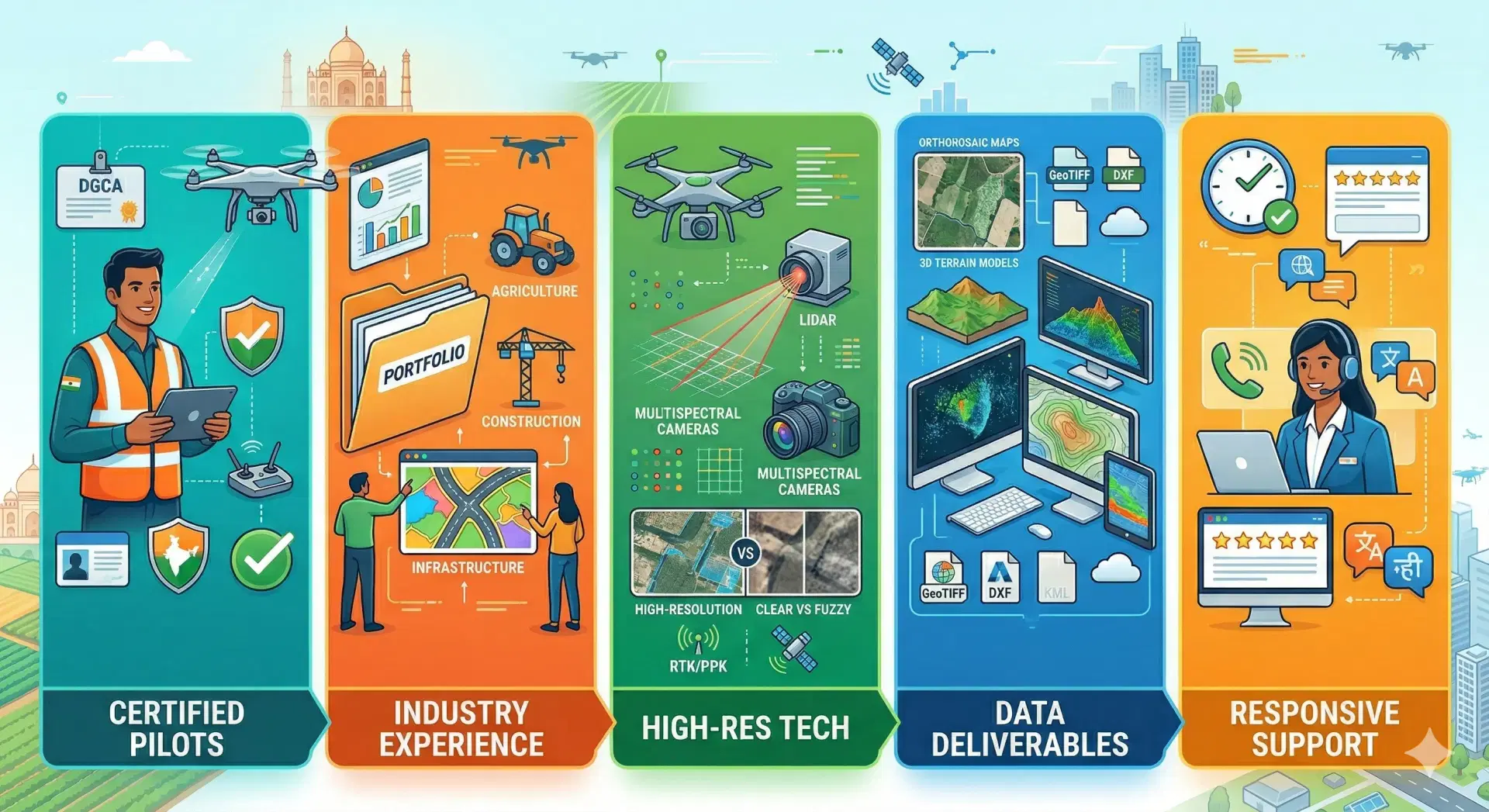
When you receive a quote from an Indian drone survey company or drone mapping services provider, verify the following before accepting:
Equipment and certification:
- Are they using DGCA type-certified drones?
- Does the pilot hold a valid Remote Pilot Certificate issued by DGCA?
- What specific drone model and sensor payload will be used on your project?
Accuracy and methodology:
- Is the survey RTK-enabled, or will GCPs be established?
- How many GCPs will be set, and by what method?
- What is the stated accuracy specification - horizontal and vertical RMSE?
Deliverables:
- What specific files will be delivered (orthomosaic, point cloud, DTM, contours)?
- In what format - GeoTIFF, LAS/LAZ, DXF, SHP?
- What is the ground resolution of the orthomosaic in cm/pixel?
- Is a survey report with accuracy assessment included?
Timeline:
- What is the confirmed field survey date?
- What is the data processing and delivery timeline?
- What is the provider's policy if weather delays the flight?
Pricing:
- Is GST (5%) included or excluded?
- Are mobilisation costs itemised separately?
- Are there additional charges for re-flights if data quality is found to be insufficient?
- Is there a programme discount if you need repeat surveys?
Tips for Getting the Best Value from Your Drone Survey Budget
Batch your surveys. If you have multiple sites or need repeat surveys across a project lifecycle, negotiate a programme rate rather than booking individual surveys. Most providers offer 20-35% discounts for committed survey programmes with defined volumes.
Specify only the deliverables you need. A full 3D point cloud with CAD-ready output costs significantly more to process than a standard orthomosaic and DTM. If your project does not require LAS files or BIM-ready output, do not pay for them.
Plan surveys during optimal seasons. The monsoon season (June-September) significantly disrupts drone operations across most of India due to cloud cover, rain, and wind. Surveys planned for October-March benefit from more reliable flying conditions, fewer weather delays, and potentially lower rates from providers with available capacity.
Provide site access and logistics support. Providers charge more when they must independently organise site access, permissions, and local logistics. Providing a site contact, access clearance, and local accommodation reduces your mobilisation cost and speeds up the project.
Ask for a sample dataset before committing to large projects. For high-value surveys, request a sample flight over a small portion of the site before committing the full budget. This verifies the provider's data quality and processing capability at low risk.
Compare deliverables, not just prices. A quote of ₹300/acre that includes only an orthomosaic is not comparable to a quote of ₹400/acre that includes an orthomosaic, DTM, contours, and a point cloud. Always compare what is actually included. Ask every provider for a standardised deliverable list and verify output formats (GeoTIFF, LAS, DXF, SHP), coordinate systems, accuracy specifications (horizontal and vertical RMSE), and ground resolution (cm/pixel). The cheapest quote often omits the processing steps that give your data real engineering or decision-making value. A ₹100/acre difference in price can translate to a ₹5-10 lakh difference in downstream project costs if you receive data that requires re-survey or manual correction.
The Hidden Cost: Data Processing and Why SaaS Changes the Equation
Most pricing discussions focus on the field survey, but 40-60% of the total project cost is in post-processing. Understanding this cost structure can significantly change how you budget for drone surveys.
Traditional Processing Model
In the conventional workflow, your survey provider flies the site, processes the raw data on local workstations, and delivers finished outputs. Processing costs are bundled into the per-acre rate, but they are substantial: a 500-acre photogrammetry project may require 48-72 hours of compute time on a high-end workstation, plus 2-3 days of manual QC and deliverable preparation. LiDAR projects with full classification can take 5-10 days. You are paying for this processing capacity whether you see it itemised or not.
Cloud-Based SaaS Processing
Cloud processing platforms allow organisations to upload raw drone data and receive professional-grade outputs without investing in processing hardware, software licences (Pix4D, Metashape), or specialist staff. The economics shift significantly:
- No hardware investment - No need for ₹3-5 lakh workstations dedicated to photogrammetry processing
- No software licences - Annual licences for professional photogrammetry software run ₹1-3 lakh per seat
- Faster turnaround - Cloud processing can compress a 3-day desktop job into hours by scaling compute resources
- Reduced vendor dependency - Organisations that process their own data can work with any field survey provider, creating competitive pressure on flight-only pricing
When SaaS Processing Makes Financial Sense
If your organisation commissions more than 5-10 drone surveys per year, or manages survey data across multiple sites and project teams, the break-even point for cloud processing is typically reached within the first year. The ROI comes not just from lower per-project processing costs, but from faster turnaround, standardised outputs, and the ability to re-process historical data as requirements evolve.
Frequently Asked Questions
What is the minimum cost of a drone survey in India?
The minimum project cost for a photogrammetry drone survey from a professional, DGCA-compliant provider is typically ₹35,000 for a site up to 1 acre, plus mobilisation. For LiDAR surveys, the minimum is also ₹35,000 for the smallest sites, but with a higher mobilisation charge of ₹10,000 near major metros.
Is GST charged on drone survey services in India?
Yes. GST on drone survey services is 18%. Drone hardware purchases are charged 5% GST. Always confirm whether quoted prices include or exclude GST.
Do I need DGCA permission for a drone survey on my property?
For most commercial surveys in Green Zone airspace, no advance permission is required beyond standard drone registration and pilot certification. However, surveys near airports, defence zones, international borders, or in Yellow or Red Zone airspace require advance permissions via the Digital Sky platform. Your provider should handle this - confirm before signing a contract.
How long does a drone survey take?
Field time is typically a few hours to one day depending on site size. A 100-acre site can be flown in under 2 hours with a capable RTK drone. Data processing and delivery typically takes 2-7 working days depending on deliverable complexity.
Can drone survey data be used for government submissions and legal purposes?
RTK drone surveys with certified GCPs can meet the accuracy requirements for many government submissions, infrastructure tendering, and engineering documentation. For legal boundary surveys or court-admissible evidence, consult your provider and the relevant authority about specific accuracy and certification requirements.
What is the difference between a photogrammetry survey and a LiDAR survey?
Photogrammetry uses overlapping aerial photographs to reconstruct a 3D model of visible surfaces. It is cost-effective and accurate on open terrain. LiDAR uses laser pulses to measure distances and can penetrate vegetation to detect ground level beneath tree canopy. LiDAR is the correct choice for forested, hilly, or corridor applications. It costs 3-10x more than photogrammetry depending on scale.
Summary: Drone Survey Pricing at a Glance - India 2026
| Project Type | Typical Cost (INR) |
|---|---|
| Small site, basic 2D map (up to 10 acres) | ₹35,000 - ₹75,000 |
| Medium site, topographic survey (10-100 acres) | ₹75,000 - ₹1,20,000 |
| Large site, per-acre photogrammetry (100-500 acres) | ₹300 - ₹500/acre |
| Very large site, per-acre photogrammetry (500+ acres) | ₹250 - ₹400/acre |
| LiDAR survey, small site (up to 100 acres) | ₹55,000 - ₹95,000 |
| LiDAR survey, large site (100-500 acres) | ₹4,600/acre |
| LiDAR survey, very large site (1,500+ acres) | ₹1,500/acre |
| Corridor survey | ₹8,000 - ₹25,000/km |
| Thermal / multispectral survey | ₹3,000 - ₹8,000/acre |
| Construction progress monitoring | ₹25,000 - ₹60,000/visit |
| Agricultural multispectral survey | ₹1,500 - ₹4,000/acre |
All prices are indicative for 2026. Add 18% GST on services unless quoted as inclusive. Actual quotes will vary based on location, terrain, accuracy requirements, deliverables, and provider.
Conclusion
Drone survey costs in India in 2026 are more competitive than at any point in the industry's history, driven by regulatory reform, growing operator supply, reduced GST, and maturing software ecosystems. For most commercial survey applications - topographic mapping, construction monitoring, volume calculations, corridor surveys - drone surveys deliver 30-70% cost savings over traditional ground methods depending on project complexity, while producing richer, more accurate datasets.
The key to getting value is understanding what drives cost, specifying your requirements precisely, and working with DGCA-compliant providers who use certified equipment and certified pilots. A quote that looks cheap but uses non-certified drones or uncertified pilots is a liability, not a saving - particularly as the Civil Drone Bill 2025 introduces criminal penalties and mandatory insurance requirements that raise the stakes for non-compliance.
India's drone survey market is growing rapidly. The projects that win will be those that adopt drone workflows strategically - not just for cost savings, but for the data density, speed, and decision-making clarity that traditional methods simply cannot match.
Don't have a drone team?
Our DGCA-certified pilots survey your project site and deliver results in 48 hours - no equipment, no software required.
Last updated: April 2026. Questions about drone survey costs for your project? Contact our team - we respond within one business day.
Related Articles
Explore more insights and stories from our blog
How to Choose a Drone Mapping Provider | Checklist
Practical checklist for choosing a drone mapping service provider. DGCA compliance, accuracy, deliverables, pricing, and red flags to watch for.
![Agisoft Metashape vs Aeroyantra: Honest Pricing & Feature Comparison [2026]](/_next/image?url=https%3A%2F%2Fdh2si8yscu98g.cloudfront.net%2Fimages%2Fblogs%2Fagisoftmetashape-vs-aeroyantra.webp&w=1920&q=75)
Agisoft Metashape vs Aeroyantra: Honest Pricing & Feature Comparison [2026]
Metashape Professional is $3,499 one-time. Aeroyantra is $0 pay-per-use or $69/month. Honest comparison: desktop photogrammetry vs cloud survey platform. Hardware costs, features, accuracy for 2026.
![DroneDeploy vs Aeroyantra: Honest Pricing & Feature Comparison [2026]](/_next/image?url=https%3A%2F%2Fdh2si8yscu98g.cloudfront.net%2Fimages%2Fblogs%2Fdronedeploy%20vs%20aeroyantra.webp&w=1920&q=75)
DroneDeploy vs Aeroyantra: Honest Pricing & Feature Comparison [2026]
DroneDeploy costs $329-$499/seat/month. Aeroyantra is pay-per-use at $2.50/credit with no seat fees. Side-by-side comparison of pricing, features, and accuracy for 2026.