
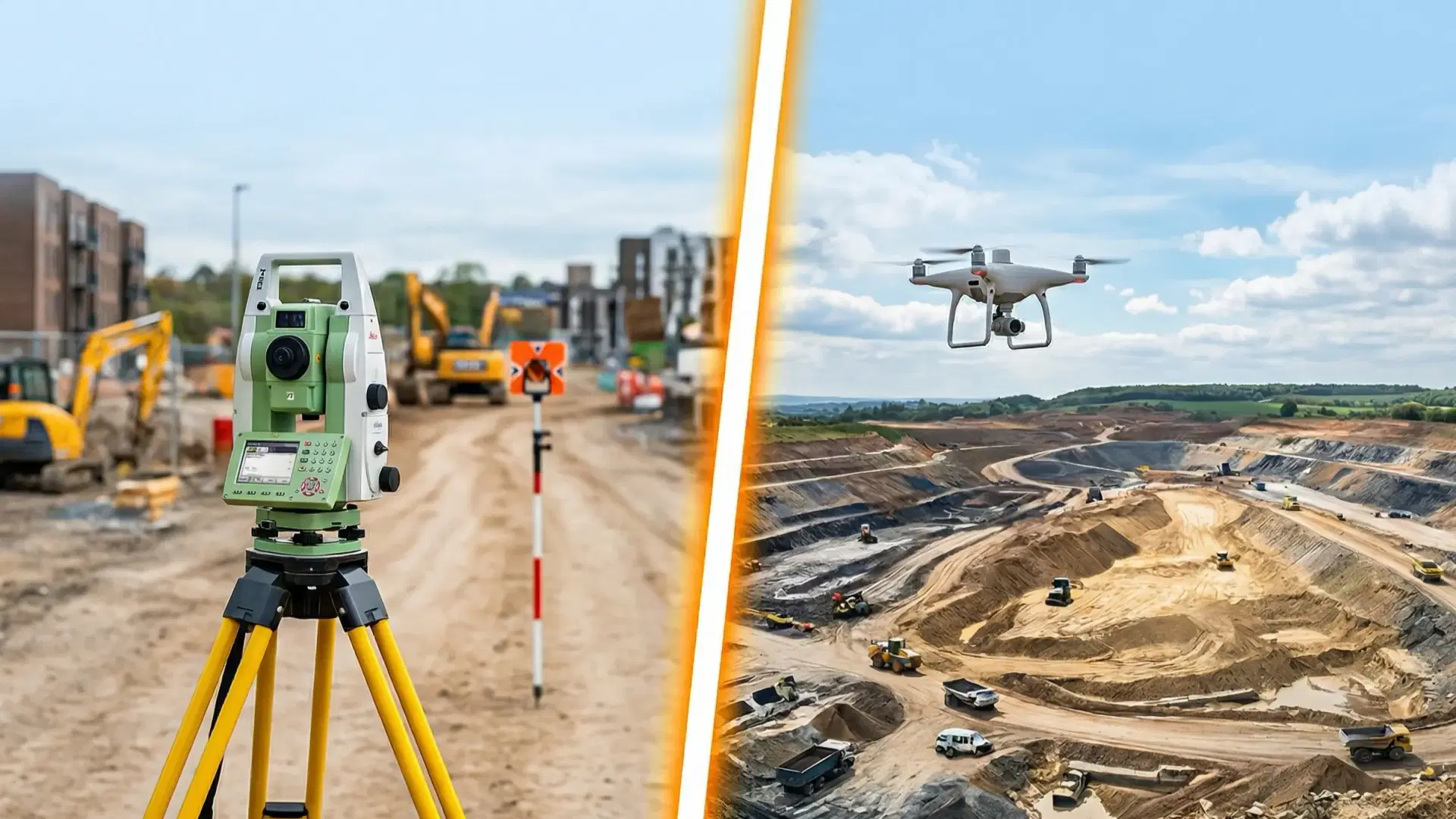
Drone Survey vs Total Station: Full Comparison
Drone survey vs total station compared on accuracy, speed, cost, and terrain. When to use each for land, mining, and construction survey projects.
Drone Survey vs Total Station: Full Comparison
Drone survey vs total station compared on accuracy, speed, cost, and terrain. When to use each for land, mining, and construction survey projects.
Table Of Content
- What You'll Learn
- The Question Nobody Actually Answers
- What Is a Total Station?
- What Is Drone Surveying and Aerial Mapping?
- Head-to-Head: Accuracy Comparison
- Speed and Field Efficiency: No Contest
- Cost Comparison: Real Numbers
- Data Quality: The Dimension That Changes Everything
- When Total Station Still Wins
- When Drone Survey Wins: Best Use Cases for Aerial Drone Survey
- The Hybrid Approach: Best of Both Worlds
- Regulatory Considerations
- Summary: Which Should You Choose?
- Conclusion
- FAQ
What You'll Learn
A practical, numbers-based comparison of drone survey vs total station - covering how each technology works, where each one breaks down, what they actually cost in 2026, and a decision framework that tells you which method to use for your specific project type.
The Question Nobody Actually Answers
The land surveying industry is undergoing its most significant transformation in decades. For over a century, the total station - a precision optical instrument combining an electronic theodolite with a distance meter - was the undisputed gold standard for land surveys. Today, drone-based surveying is challenging that dominance with a compelling combination of speed, data density, and cost efficiency that is forcing surveyors, engineers, and project managers worldwide to reconsider their workflows.
But this is not a simple "old vs new" debate. Both technologies have genuine strengths, and choosing the wrong one for a given project can mean wasted budgets, inaccurate deliverables, or legal complications. This guide breaks down the real differences - accuracy numbers, cost data, use cases, and limitations - so you can make an informed decision.
What Is a Total Station?
A total station is an electronic surveying instrument that measures horizontal angles, vertical angles, and slope distances from a fixed setup point. The operator physically stations the instrument at a known location, aims at a reflective prism or target, and records individual coordinate points (X, Y, Z) with sub-millimetre precision.
Modern robotic total stations can track a moving prism automatically, enabling a single surveyor to operate without an assistant. High-end units from manufacturers such as Trimble, Leica, and Topcon are capable of achieving angular accuracy down to 0.5 arc seconds and distance accuracy of 1-2 mm + 2 ppm.
Total stations are the reference standard. The American Society for Photogrammetry and Remote Sensing (ASPRS) and the National Geodetic Survey (NGS) in the United States recognise total station surveys as the benchmark for horizontal and vertical geodetic control - the foundation against which all other methods are validated.
What Is Drone Surveying and Aerial Mapping?
Drone surveying - also referred to as aerial drone survey, UAV photogrammetry, or drone survey mapping - uses an aerial platform equipped with either a high-resolution camera or a LiDAR sensor to capture spatial data across an entire site in a single flight. Survey drones are now the preferred tool for drones for surveying and mapping across construction, mining, and infrastructure sectors.
Photogrammetry drones capture overlapping images that are processed by software such as Pix4D, Agisoft Metashape, or DJI Terra to reconstruct 3D point clouds, orthomosaic maps, and Digital Terrain Models (DTMs).
LiDAR drones emit millions of laser pulses per second, measuring precise distances to create extremely dense point clouds - even beneath tree canopy, a capability photogrammetry cannot match.
Accuracy depends heavily on the technology used:
- Standard GPS-tagged drones: 10-30 cm accuracy
- RTK (Real-Time Kinematic) drones with Ground Control Points (GCPs): 1-3 cm accuracy
- Premium videogrammetry platforms: down to 2.5 mm accuracy
RTK technology - a GPS correction system that geotags each image with precise coordinates in real time - has been the game changer that elevated drone surveying from a mapping tool into a genuine survey-grade solution.
Head-to-Head: Accuracy Comparison
This is the question every project manager asks first, and the answer is more nuanced than most articles admit.
| Metric | Total Station | RTK Drone Survey | Standard Drone Survey |
|---|---|---|---|
| Point Accuracy | 1-3 mm | 1-3 cm | 10-30 cm |
| Coverage Type | Individual selected points | Every visible surface | Every visible surface |
| Data Density | Sparse (hundreds of points) | Millions of points | Millions of points |
| Vertical RMSE | ~1.3 cm (GNSS baseline) | ~3-10 cm | ~10+ cm |
| Under Canopy | Yes (line-of-sight) | LiDAR only | No |
The core trade-off is pinpoint precision versus comprehensive coverage.
A total station gives you millimetre accuracy - but only at the specific points the operator physically measures. A drone gives you centimetre accuracy across every single visible surface of a site simultaneously.
A 2026 peer-reviewed study comparing DJI Mavic Air 2 UAV photogrammetry (processed in Pix4D) against a Trimble total station across flat, undulating, and semi-urban terrain at Kathmandu University found that the drone DTM closely matched the total station DTM on flat and lightly vegetated areas, with near-zero mean difference. The largest errors occurred on steep hillside terrain, where geolocation issues introduced systematic offsets.
For boundary surveys, construction machine control layout, or any application requiring sub-5 cm absolute precision at specific legal points, the total station remains the gold standard. For topographic mapping, volume calculations, progress monitoring, and large-area planning, RTK drone surveying is not just comparable - it frequently delivers superior results due to data density.
Speed and Field Efficiency: No Contest
Field time is where the comparison becomes stark.
| Scenario | Total Station | Drone Survey |
|---|---|---|
| Setup time | 10-15 minutes | 2-3 minutes |
| 50-acre site | 2-3 days (2-person crew) | Under 2 hours (1 pilot) |
| 100-acre site | 5-7 days (2-person crew) | 3-4 hours (1 pilot) |
| Data output | XYZ coordinate list | 3D model, point cloud, orthomosaic |
| Personnel required | Minimum 2 surveyors | 1 licensed pilot |
A drone can cover 100+ acres in under an hour - terrain that would take a traditional crew an entire working week. That is not an exaggeration: a 2025 comparison by Rock Robotic found that a traditional two-person survey crew required 5-7 full days to complete a 100-acre forested site, while a drone LiDAR workflow completed the same project in 3-4 hours.
This speed advantage compounds over time. A surveying firm that switches to drone workflows can move from completing one 100-acre project per week to completing several per day - a fundamental shift in business capacity.
Cost Comparison: Real Numbers
The financial case for drone surveying is compelling for most project types.
US Market Pricing
Traditional survey - 50-acre site:
- 2-3 surveyors at $75-$125/hour
- 2-3 days field time + 1-2 days processing
- Total labour, equipment, and processing: $3,500-$7,000+
RTK drone survey - same 50-acre site:
- 1 pilot/technician
- Under 2 hours flight time
- Processing with Pix4D or Metashape
- Total cost: $800-$2,000
Indian Market Pricing
Traditional survey - 20-hectare (50-acre) site:
- 2-3 surveyors at ₹800-₹1,500/hour
- 2-3 days field time + 1-2 days processing
- Total labour, equipment, and processing: ₹2,50,000-₹5,00,000+
RTK drone survey - same 20-hectare site:
- 1 pilot/technician
- Under 2 hours flight time
- Processing with Aeroyantra or similar platforms
- Total cost: ₹60,000-₹1,50,000
That represents a 50-70% reduction in per-project cost across both markets. For firms running repeat surveys across multiple sites, the savings scale dramatically. Propeller Aero's analysis showed that surveying ten 120-acre sites five times per year costs approximately $120,000 (₹1 crore) using traditional methods - and just $6,000 (₹5 lakh) with drone surveying. That is a $114,000 (₹95 lakh) annual saving on a single programme.
Equipment Investment Comparison
| Equipment | US Market | Indian Market |
|---|---|---|
| Professional Total Station | $15,000-$50,000 | ₹12 lakh-₹40 lakh |
| RTK Mapping Drone | $1,000-$10,000 | ₹80,000-₹8 lakh |
| Photogrammetry Software | Free-$350/month | Free-₹25,000/month |
Most surveying firms recoup drone hardware costs within a handful of projects.
A 2024 industry study cited by Florida Aerial Survey found that traditional surveys led to an average 18% rework cost due to measurement gaps and interpolation errors. Drone surveys, with their dense point cloud coverage, reduce rework costs by 15-25% - an often-overlooked saving that significantly improves total project economics.
Data Quality: The Dimension That Changes Everything
This is where drone surveying's advantage becomes most apparent to engineers and project managers who have worked with both datasets.
A total station survey of a 100-acre site might produce hundreds or a few thousand measured points. A drone survey of the same site produces millions of data points - a comprehensive 3D reconstruction of every visible surface.
The practical implications are significant:
Volume calculations are far more accurate with drone data. Traditional surveying involves substantial interpolation between measured points, creating a 5% or greater quantity variance. Drone surveys reduce this variance to 1-3%, which on large earthworks projects can translate to savings of $25,000-$50,000 per programme.
Orthomosaic maps provide a georeferenced aerial photograph overlaid with accurate measurements - something a total station cannot produce at all. These deliverables are increasingly required by clients for project documentation, planning submissions, and as-built records.
3D models and point clouds allow engineers to conduct measurements, cross-sections, and analysis in the office rather than returning to site repeatedly. The DJI Zenmuse L2 LiDAR sensor, for example, captures 1.2 million points per second with five returns per pulse, enabling ground detection even beneath dense foliage.
When Total Station Still Wins
Despite the impressive case for drone surveying, there are specific scenarios where the total station remains the correct tool.
Legal boundary surveys. In most US states and many jurisdictions globally, boundary surveys establishing legal property lines must be performed by a licensed land surveyor using methods that achieve certified monumentation accuracy. Total stations meet this requirement by default; drone surveys may or may not, depending on local regulations and the accuracy achieved.
Sub-centimetre precision requirements. Projects requiring accuracy tighter than 1 cm - such as structural deformation monitoring, machine control layout for precision grading, or geodetic control point establishment - still require total station or RTK GNSS methods. Modern TS/RTK surveys routinely achieve a few millimetres of vertical accuracy; drone photogrammetry on flat terrain achieves RMSE on the order of centimetres.
Dense urban environments and obstructed areas. GPS signal degradation in urban canyons, under bridges, or inside structures limits drone accuracy. Total stations work by line-of-sight, making them effective in these constrained environments.
Areas under dense canopy. Photogrammetry drones cannot see through foliage. While LiDAR drones with multi-return capability can penetrate vegetation to detect ground level, photogrammetry-based surveys in heavily forested areas will produce incomplete or inaccurate terrain models. Traditional surveying with a total station remains the reliable option here.
Utility and infrastructure layout. Locating specific underground utility positions, setting out construction stakes, or verifying precise point locations for structural work requires the ground-level, point-specific precision that total stations provide.
When Drone Survey Wins: Best Use Cases for Aerial Drone Survey
For the majority of modern land survey applications, drone surveying and mapping delivers superior outcomes.
Drone land survey for large-area topographic mapping. Any site over 5-10 acres where comprehensive terrain data is needed - road corridors, mining sites, agricultural land, development plots - is a strong aerial drone survey use case. Coverage speed and data density are unmatched.
Construction progress monitoring. Weekly or bi-weekly drone surveys of active construction sites provide accurate earthwork volume tracking, compliance documentation, and progress reporting at a fraction of the cost of traditional surveys. AI-enhanced drones can detect anomalies such as uneven grading or material shifts in real time.
Infrastructure inspection. Power line corridors, pipeline routes, and road networks that would require weeks of traditional survey can be completed in hours with drone LiDAR. A 2025 case study found that drone inspection of a solar farm reduced fault detection time from 20-25 days to 2 days, while improving fault detection accuracy from 60% to over 95%.
Corridor mapping. Railway, highway, and utility corridor surveys benefit enormously from drone efficiency. DJI's Matrice 300 RTK with Zenmuse P1 reduced operation preparation time by two hours on a railroad survey project compared to total station methods, while producing a richer dataset.
Hazardous terrain. Cliffs, steep slopes, active construction zones, and flood-prone areas present genuine safety risks to ground-based survey crews. Drones eliminate field exposure entirely.
Repeated monitoring surveys. Any project requiring multiple surveys over time - stockpile volume tracking, land subsidence monitoring, coastal erosion assessment - benefits from the speed and repeatability of drone workflows.
The Hybrid Approach: Best of Both Worlds
The most sophisticated surveying workflows in 2026 do not choose between total stations and drones - they use both strategically.
The standard hybrid approach works as follows:
- Total station establishes GCPs. A surveyor uses a total station or RTK GNSS receiver to establish a network of Ground Control Points with millimetre-level geodetic accuracy.
- Drone captures the full site. The drone flight uses the GCPs to georeference the photogrammetric model, achieving 1-3 cm absolute accuracy across the entire site.
- Total station validates critical points. For legal boundaries or high-precision structural points, the total station verifies specific locations within the drone dataset.
This hybrid method is increasingly standard in forensic engineering, public safety documentation, and large infrastructure projects. It delivers the absolute accuracy of traditional surveying at specific control points combined with the comprehensive coverage and data density of drone mapping - at a fraction of the cost and time of a pure total station approach.
Regulatory Considerations
US Market
For US-based survey professionals and project managers, regulatory compliance is a practical consideration when adopting drone surveying.
FAA Part 107 certification is required for all commercial drone operations in the United States. Pilots must pass a knowledge test covering airspace regulations, weather, and flight operations. Operations near airports, in controlled airspace, or above 400 feet AGL require additional authorisations via the LAANC system or FAA waivers.
State surveying board regulations vary significantly. Some states require that any survey used for legal purposes be performed by or under the direct supervision of a licensed Professional Land Surveyor (PLS), regardless of the technology used. Drone data can satisfy this requirement when the PLS certifies the work - but project managers should verify local requirements before committing to a drone-only workflow for boundary or legal surveys.
ASPRS Positional Accuracy Standards provide the technical benchmark for drone survey deliverables. Meeting Class 1 or Class 2 accuracy standards with RTK drone systems is achievable on suitable terrain and is increasingly accepted for most engineering and documentation applications.
Indian Market
For Indian survey professionals and project managers, compliance with DGCA regulations is mandatory for commercial drone operations.
Drone Registration and Classification under Drone Rules 2021:
- Nano (under 250g): Minimal restrictions, no registration required
- Micro (250g to 2kg): Registration required on Digital Sky Platform
- Small (2kg to 25kg): Registration + UAOP required (most mapping drones fall here)
- Medium (25kg to 150kg): Full commercial licensing required
UAS Operator Permit (UAOP) is mandatory for commercial operations with Small category drones and above. This permit is obtained through the Digital Sky Platform after submitting required documentation including insurance, drone specifications, and operational procedures.
Remote Pilot Certificate (RPC) must be obtained through a DGCA-approved training organization. The training covers flight operations, airspace regulations, emergency procedures, and meteorology. Valid for 10 years from date of issue.
Airspace Clearance via Digital Sky Platform:
- Green Zone: No prior permission needed for flights up to 400 feet AGL (120 meters)
- Yellow Zone: Permission required at least 24 hours in advance through Digital Sky
- Red Zone: Restricted airspace - no civilian drone operations permitted
Survey-Specific Considerations:
- Licensed surveyors in India must certify drone survey data for legal boundary work and government submissions
- For mining and quarrying projects, survey data must meet IBM (Indian Bureau of Mines) standards
- Infrastructure projects may require additional clearances from local authorities
Important: The Digital Sky map is updated regularly. Always check airspace classification before every flight - a site that was Green zone last month may have changed. Non-compliance can result in fines up to ₹1 lakh and equipment confiscation.
Summary: Which Should You Choose?
| Project Type | Recommended Method |
|---|---|
| Legal boundary survey | Total Station |
| Sub-centimetre precision layout | Total Station |
| Topographic mapping (5+ acres) | Drone (RTK) |
| Volume calculations | Drone (RTK) |
| Construction progress monitoring | Drone |
| Corridor / infrastructure survey | Drone (LiDAR) |
| Dense canopy / forested terrain | Drone (LiDAR) or Total Station |
| Urban canyon / obstructed site | Total Station |
| Hazardous terrain | Drone |
| Repeat monitoring surveys | Drone |
| Large-area as-built documentation | Drone |
| Geodetic control establishment | Total Station / RTK GNSS |
Conclusion
The question "drone survey vs total station" rarely has a single correct answer - it depends on project scale, accuracy requirements, terrain, legal obligations, and budget. But the data makes one thing clear: for the majority of modern land survey applications, RTK drone surveying delivers faster results, richer data, and significantly lower costs than traditional total station methods.
Total stations remain irreplaceable for legal boundary work, sub-centimetre precision requirements, and geodetic control establishment. For everything else - topographic mapping, volume tracking, progress monitoring, corridor surveys, and large-area documentation - drone surveying is not just competitive, it is superior.
The most forward-thinking survey firms are not debating which technology to use. They are building hybrid workflows that leverage the millimetre precision of total stations where it genuinely matters, and the speed, coverage, and data density of drones everywhere else. That combination is where the future of land surveying lies.
FAQ
Which is more accurate - drone survey or total station?
Total stations achieve 1-3 mm point accuracy, while RTK drone surveys achieve 1-3 cm accuracy. However, total stations measure only specific points, while drones capture millions of points across the entire site. For applications requiring sub-centimetre precision at specific locations (boundary surveys, machine control), total stations are more accurate. For comprehensive terrain mapping and volume calculations, drones provide superior data density.
How much does a drone survey cost compared to a total station survey?
In the US market, a 50-acre drone survey typically costs $800-$2,000, while the same area surveyed with a total station costs $3,500-$7,000+. In India, a 20-hectare (50-acre) drone survey costs ₹60,000-₹1,50,000 compared to ₹2,50,000-₹5,00,000+ for traditional total station surveys. The cost difference increases with site size. Equipment investment is also lower: RTK drones cost $1,000-$10,000 (₹80,000-₹8 lakh) vs $15,000-$50,000 (₹12 lakh-₹40 lakh) for professional total stations.
Can drone surveys replace total stations for legal boundary surveys?
In most jurisdictions, legal boundary surveys must be performed by a licensed land surveyor using methods that meet specific accuracy standards. Total stations meet these requirements by default. Drone surveys can supplement boundary work but typically cannot replace total station measurements for legal monumentation. Check your local surveying board regulations.
How long does a drone survey take compared to a total station survey?
A drone can survey 50 acres in under 2 hours with one operator. The same area requires 2-3 days with a 2-person total station crew. For 100-acre sites, drones complete the work in 3-4 hours vs 5-7 days for traditional methods.
What is RTK and why does it matter for drone surveying?
RTK (Real-Time Kinematic) is a GPS correction system that provides centimetre-level positioning accuracy. RTK drones geotag each image with precise coordinates in real time, eliminating or reducing the need for ground control points. This technology elevated drone surveying from a mapping tool to a survey-grade solution capable of 1-3 cm accuracy.
When should I use a total station instead of a drone?
Use a total station for: legal boundary surveys, sub-centimetre precision requirements, dense urban environments with GPS interference, areas under dense canopy (if not using LiDAR), utility layout work, and geodetic control point establishment. Total stations excel at precise point measurements in constrained environments.
Can I use both drone and total station together?
Yes - and this hybrid approach is increasingly standard. Use a total station to establish precise ground control points, fly a drone to capture comprehensive site data, then validate critical points with the total station. This combines millimetre precision at control points with complete site coverage and data density.
Don't have a drone team?
Our DGCA-certified pilots survey your survey site and deliver results in 48 hours - no equipment, no software required.
Last updated: April 2026. Questions about drone surveying vs traditional methods for your project? Contact our team - we respond within one business day.
Related Articles
Explore more insights and stories from our blog
![Agisoft Metashape vs Aeroyantra: Honest Pricing & Feature Comparison [2026]](/_next/image?url=https%3A%2F%2Fdh2si8yscu98g.cloudfront.net%2Fimages%2Fblogs%2Fagisoftmetashape-vs-aeroyantra.webp&w=1920&q=75)
Agisoft Metashape vs Aeroyantra: Honest Pricing & Feature Comparison [2026]
Metashape Professional is $3,499 one-time. Aeroyantra is $0 pay-per-use or $69/month. Honest comparison: desktop photogrammetry vs cloud survey platform. Hardware costs, features, accuracy for 2026.
![DroneDeploy vs Aeroyantra: Honest Pricing & Feature Comparison [2026]](/_next/image?url=https%3A%2F%2Fdh2si8yscu98g.cloudfront.net%2Fimages%2Fblogs%2Fdronedeploy%20vs%20aeroyantra.webp&w=1920&q=75)
DroneDeploy vs Aeroyantra: Honest Pricing & Feature Comparison [2026]
DroneDeploy costs $329-$499/seat/month. Aeroyantra is pay-per-use at $2.50/credit with no seat fees. Side-by-side comparison of pricing, features, and accuracy for 2026.
![Pix4D vs Aeroyantra: Honest Pricing & Feature Comparison [2026]](/_next/image?url=https%3A%2F%2Fdh2si8yscu98g.cloudfront.net%2Fimages%2Fblogs%2Fpix4d-vs-aeroyantra.webp&w=1920&q=75)
Pix4D vs Aeroyantra: Honest Pricing & Feature Comparison [2026]
Pix4D sells 6 separate products from $49 to $4,990+. Aeroyantra is one platform at $2.50/credit, no perpetual license. Side-by-side comparison of pricing, accuracy, and workflow for 2026.