

IBM Rule 34A Drone Survey Compliance Guide 2026
Complete IBM Rule 34A and MCDR 2017 guide for drone survey compliance in mining. Submission timelines, deliverables, and survey requirements explained.
IBM Rule 34A Drone Survey Compliance Guide 2026
Complete IBM Rule 34A and MCDR 2017 guide for drone survey compliance in mining. Submission timelines, deliverables, and survey requirements explained.
Table Of Content
- What You'll Learn
- Why This Matters More Than Most Operators Realize
- Who Is Covered: The Rule 34A Thresholds
- The Four Trigger Events That Require a Survey
- Exact Technical Specifications: What the SOP Actually Says
- The Complete Submission Checklist
- Consequences of Non-Compliance: What IBM Can Do
- The Seven Most Common Reasons Submissions Are Rejected
- Building a Compliance Workflow That Scales
- How Aeroyantra Handles IBM Compliance End-to-End
- Pre-Survey Checklist
- FAQ
- The Bottom Line
What You'll Learn
The complete, specification-exact guide to Rule 34A compliance - who it applies to, every technical requirement from the March 2023 IBM SOP, the full submission checklist, the consequences of getting it wrong, and how to build a workflow that produces audit-proof deliverables every year.
Why This Matters More Than Most Operators Realize
Most mining operators know Rule 34A exists. Fewer understand that the IBM's enforcement posture has hardened significantly since the 2021 amendment.

IBM inspection teams now conduct surprise audits at mine sites and cross-reference submitted drone data against satellite imagery to detect discrepancies. Violations documented in IBM inspection letters from 2024 show that incomplete or inaccurate submissions are treated not as administrative oversights but as potential evidence of illegal mining activity - triggering Rule 45(7) proceedings that can lead to suspension of all mining operations and, in serious cases, lease termination.
The stakes are not bureaucratic. A rejected submission or a failed audit does not result in a fine you pay and move on from. It can shut down your mine.
This guide exists because the IBM's SOP is a technical document written for surveyors, not mine managers. The goal here is to translate every requirement into plain language with exact numbers - so your compliance team knows precisely what is required, and your drone survey produces data that passes on the first submission.
Who Is Covered: The Rule 34A Thresholds
Rule 34A of the Mineral Conservation and Development Rules (MCDR), 2017 - as amended in 2021 - applies to every mining lessee meeting either of the following criteria:
Criterion A: Annual excavation plan of 1 million tonnes or more in a given year
Criterion B: Leased area of 50 hectares or more
Either criterion triggers the full compliance obligation. A 60-hectare lease with a modest excavation plan is covered. A high-volume operation on a 45-hectare lease is covered under Criterion A.
Important: The rule applies to the annual excavation plan, not actual production. If your approved mining plan projects 1 million tonnes, you are covered - regardless of whether you achieve that production.
What about smaller mines?
Mines below both thresholds are not covered by Rule 34A's mandatory annual drone survey requirement. However, they remain subject to the mining plan submission requirement under Rule 34A(3) - which triggers a mandatory drone survey before any mining plan submission or modification to IBM. This affects virtually all active mining operations at some point.
The Four Trigger Events That Require a Survey
Rule 34A creates four distinct compliance triggers, each with its own deadline and submission destination.
Trigger 1: Annual Compliance Survey (Sub-rule 1)
Who: All lessees meeting the 1 million tonne or 50-hectare threshold
When to fly: April or May of each year
Submission deadline: On or before 1st July of the same year
Submit to: Controller General, Indian Bureau of Mines, Nagpur
Also submit to: The relevant State Government (per the March 2023 SOP update)
This is the primary annual compliance obligation. Missing the 1st July deadline is a compliance failure regardless of data quality.
Trigger 2: Mining Plan Submission Survey (Sub-rule 3)
Who: Any lessee submitting a new mining plan or modification to IBM
When to fly: Within 6 months before submission of the mining plan document
Submission deadline: On or before 1st July preceding the mining plan submission
Note: A lessee who has already submitted under Trigger 1 for that year is exempt from Trigger 2 for the same year.
Trigger 3: New Lease / Preferred Bidder Survey (Sub-rule 4)
Who: All preferred bidders issued a Letter of Intent for grant of a mining lease
When to fly: Before submitting the mining plan with the lease application
Submit to: Both the Regional Controller and the Controller General, IBM
This survey establishes the baseline condition of the mining block before any operations begin - making it the most legally significant of the four triggers.
Trigger 4: Mine Closure Survey
Who: Any lessee initiating mine closure proceedings
Purpose: To document the final condition of the lease area for closure plan approval and reclamation verification
Summary of Trigger Events
| Trigger | Who | Fly By | Submit By | Submit To |
|---|---|---|---|---|
| Annual (Sub-rule 1) | 1 MT+ or 50 ha+ lessees | April/May | 1st July | Controller General + State Govt |
| Mining plan submission | Any lessee submitting/modifying plan | Within 6 months before submission | 1st July before submission | Controller General |
| New lease | Preferred bidders | Before mining plan submission | With mining plan | Regional Controller + Controller General |
| Mine closure | Closing lessees | Before closure plan | With closure plan | Controller General |
Exact Technical Specifications: What the SOP Actually Says
This is where most compliance failures happen. The IBM SOP (updated March 2023) contains specific numerical requirements that many operators are unaware of - or are meeting with the wrong values. Every number below is sourced directly from the official IBM SOP.
Drone and Camera Requirements
Camera resolution: Minimum 20 megapixels RGB camera. The camera must be capable of capturing high-quality undistorted images.
Mechanical shutter: Strongly recommended. A rolling shutter introduces geometric distortion that compounds across thousands of images and can cause GCP residuals to exceed the 5 cm RMSE threshold.
GSD requirement: Images must be captured at 5 cm GSD or better (5 cm per pixel or less). This is a hard floor - coarser imagery will be rejected.
DGCA compliance: All drones must be DGCA-approved and possess mandatory safety features as notified by DGCA. No IBM registration is required for drone agencies, but DGCA permissions must be obtained before flying in Yellow and Red airspace zones.
Flight Planning Requirements
Forward (front) overlap: Minimum 80%
Lateral (side) overlap: Minimum 70%
Camera angle: Nadir (vertically downward, 90 degrees) during the main survey pass
Flying height: As per DGCA prescribed limits, subject to achieving the 5 cm GSD requirement
Survey area: Must cover the entire mining lease area plus 100 metres outside the lease boundary on all sides. For leases sharing a common boundary with another lease, the buffer may be limited to the lease boundary on the shared side.
Flight path documentation: The flight path plan and number of flights taken to cover the entire area must be submitted to IBM along with the output data.
Ground Control Point (GCP) Requirements
This is the most technically demanding section of the SOP and the most common source of rejection.
GCP density: Minimum 5 GCPs per square kilometre of lease area, or part thereof. For lease areas less than 1 sq. km., minimum 4 GCPs are required.
Distribution: GCPs must be well distributed across the entire survey area. Clustering in accessible areas while leaving gaps elsewhere is a compliance failure.
Permanent GCPs: At least 3 permanent GCPs must be placed at undisturbed locations within the lease area. These must be resurveyed in every subsequent annual survey to enable cross-checking of change detection accuracy.
GCP dimensions: Minimum 50 cm x 50 cm, marked as an X with high-contrast colours. Size should be increased proportionally if flying at higher altitudes.
GCP accuracy: RMSE of GCPs must be less than 5 cm. This requires a calibrated/certified DGPS instrument - a standard consumer GNSS receiver is not sufficient.
Boundary pillars: Must NOT be used as permanent GCPs.
GCP survey instrument: Calibrated/certified DGPS instrument only.
Output Data Specifications
The March 2023 SOP update added significant precision to output format requirements. Every file must meet these exact specifications.
Orthomosaic:
- Format: GeoTIFF with metadata
- Coordinate system: UTM projected coordinate system
- Resolution: 5 cm per pixel or better (GSD ≤ 5 cm)
- Coverage: Full lease area including 100 m buffer zone
Digital Elevation Model (DSM and DTM):
- Format: GeoTIFF
- Coordinate system: UTM projected coordinate system
- Spatial resolution: 15 cm per pixel or better
- Coverage: Must include the 100 m buffer zone (this was clarified in the March 2023 update - the previous SOP was ambiguous on buffer inclusion for DEMs)
Feature Shapefile (Land Use Map):
- Format: Shapefile (.shp) with all associated files (.dbf, .shx, .prj)
- Coordinate system: UTM projected coordinate system
- Geometry type: Polygon
- All features must be in a single shapefile with proper nomenclature in the attribute data
Required features to be mapped and included in the shapefile:
| Feature | Description |
|---|---|
| ML Boundary | Mining lease boundary polygon |
| Excavation area | Active pits, quarries, benches |
| Waste dump | Overburden and waste rock dumps |
| Topsoil stack | Segregated topsoil stockpiles |
| Backfilled area | Reclaimed and backfilled zones |
| Afforestation / green belt | Planted areas within lease |
| Infrastructure | Buildings, processing plants |
| Roads and railways | Internal haul roads and rail lines |
| Tailing pond | Tailings storage facilities |
| Effluent treatment plant | ETP location and extent |
| Mineral separation plant | Processing facility footprint |
| Township area | Residential and administrative areas |
| Others | Any additional features with specification |
GCP Data Files (three separate files required):
- Total GCPs + DGPS server data (including permanent GCPs): Excel format, both GCS WGS84 and UTM projected coordinate system
- Permanent GCP data only: Excel format, both GCS WGS84 and UTM projected coordinate system
- GCP plan: Shapefile format, UTM projected coordinate system
Boundary Pillar Coordinates (two separate shapefiles required):
- Shapefile 1: UTM projected coordinate system
- Shapefile 2: GCS WGS84 coordinate system
- Also: Excel file in both GCS WGS84 and UTM
Coordinate precision for WGS84 data: Must be submitted in format DD MM SS.SSSSSS (degrees, minutes, seconds to 6 decimal places in seconds). This precision requirement is frequently missed and causes rejection.
RMSE Report:
- Formats: .txt, .doc, and .PDF (all three required - the March 2023 update made PDF mandatory)
- Must document the RMSE of the survey with GCP residuals
- Must demonstrate RMSE less than 5 cm
Drone Survey Log Sheet:
- Formats: .doc and .PDF (both required - the March 2023 update added PDF as mandatory)
- Must include airspace clearance documentation, flight parameters, and operator credentials
Data retention: The lessee must retain both raw and processed data for a minimum of 5 years. IBM may request raw data for verification at any time during this period.
The Complete Submission Checklist
Use this as your final verification before submission. Every item must be confirmed.
Raster Data
- Orthomosaic: GeoTIFF, UTM coordinate system, GSD ≤ 5 cm, includes 100 m buffer
- DSM: GeoTIFF, UTM coordinate system, resolution ≤ 15 cm, includes 100 m buffer
- DTM: GeoTIFF, UTM coordinate system, resolution ≤ 15 cm, includes 100 m buffer
Vector Data
- Feature shapefile: All required features mapped, UTM coordinate system, polygon geometry, correct attribute nomenclature
- GCP plan shapefile: UTM coordinate system
- Boundary pillar shapefile (UTM): Separate file
- Boundary pillar shapefile (WGS84): Separate file
Tabular Data
- Total GCP + DGPS server data: Excel, both WGS84 and UTM, precision to DD MM SS.SSSSSS
- Permanent GCP data: Excel, both WGS84 and UTM
- Boundary pillar coordinates: Excel, both WGS84 and UTM
Reports and Documentation
- RMSE report: .txt, .doc, and .PDF (all three)
- Drone survey log sheet: .doc and .PDF (both)
- Flight path plan and number of flights
- DGCA airspace clearance documentation
Verification
- All GCP RMSE values are below 5 cm
- Minimum GCP density met (5 per sq. km., minimum 4 for areas under 1 sq. km.)
- At least 3 permanent GCPs established at undisturbed locations
- 100 m buffer zone covered in all raster and vector outputs
- Submission addressed to Controller General, IBM, Nagpur
- Copy submitted to State Government
- Raw and processed data archived for 5-year retention
Consequences of Non-Compliance: What IBM Can Do
The IBM has a range of enforcement tools under MCDR 2017, and inspection records from 2024 show they are being used actively.
Immediate consequences
Rejection and re-submission requirement. If submitted data does not meet technical specifications - wrong coordinate system, insufficient GSD, missing files, GCP RMSE above 5 cm - the submission is rejected and must be corrected and resubmitted. If the deadline has passed, you are in violation.
Rule 62 prosecution. Violations of MCDR provisions constitute an offence punishable under Rule 62. IBM inspection letters issued in 2024 routinely cite Rule 62 in violation notices.
Escalating consequences
Suspension of mining operations. Under Rule 45(7) of MCDR 2017, the Regional Controller of Mines can order suspension of all mining operations in the mine if incomplete, wrong, or false information is found in submissions. The suspension remains in force until compliance is demonstrated.
Lease termination recommendation. Where data suppression or misrepresentation indicates potential abetment of illegal mining, IBM can recommend termination of the mining lease to the State Government.
Prosecution initiation. IBM can initiate prosecution proceedings independently of the suspension order.
The critical point: IBM cross-references drone survey data against satellite imagery and previous surveys. A submission that shows excavation volumes inconsistent with production returns, or that omits areas of activity visible in satellite data, is not treated as a technical error - it is treated as potential evidence of illegal mining. The consequences of that classification are severe.
What "incomplete" means in practice
IBM inspection records show that common violations triggering enforcement action include:
- Plans and sections not updated on schedule (Rule 31(4))
- Annual returns with incomplete or inconsistent data (Rule 45(7))
- Drone survey data that does not match approved mining plan proposals
- Production figures that deviate significantly from approved plans without explanation
A drone survey that is technically compliant but whose volumetric data contradicts your production returns creates a compliance problem that extends well beyond the drone survey itself.
The Seven Most Common Reasons Submissions Are Rejected
These are the technical failures that appear most frequently in rejected submissions.
1. Wrong coordinate system for orthomosaic
The orthomosaic must be in UTM projected coordinate system. Submissions in WGS84 geographic coordinates are rejected. This is the single most common format error. Verify the EPSG code of your output file before submission - for most of India, the correct UTM zone is 43N (EPSG: 32643) or 44N (EPSG: 32644) depending on location.
2. GSD exceeding 5 cm
Flying too high, using a low-resolution camera, or processing at reduced quality settings can result in orthomosaics coarser than 5 cm GSD. The GSD must be verified in the output file metadata, not estimated from flight parameters.
3. Missing 100 m buffer zone
The buffer zone must be included in the orthomosaic, DSM, DTM, and feature shapefile. Submissions that cover only the lease boundary are rejected. This is particularly common when operators clip their outputs to the lease boundary for tidiness.
4. Insufficient GCP density or poor distribution
Five GCPs per square kilometre is a minimum, not a target. More critically, GCPs clustered in accessible areas while leaving large portions of the lease unsupported will produce RMSE values that exceed 5 cm in the unsupported zones - even if the overall average looks acceptable.
5. GCP RMSE above 5 cm
The RMSE report must demonstrate sub-5 cm accuracy. Using a consumer GNSS receiver instead of a calibrated DGPS instrument, or establishing GCPs on unstable ground, are the most common causes of RMSE failures.
6. Missing or incomplete file formats
The March 2023 SOP update added PDF as a mandatory format for both the RMSE report and the drone survey log sheet. Submissions that include only .txt and .doc versions of the RMSE report are now non-compliant. Similarly, boundary pillar coordinates must be submitted as two separate shapefiles (UTM and WGS84) - a single shapefile is insufficient.
7. WGS84 coordinate precision below 6 decimal places in seconds
The SOP specifies coordinates in format DD MM SS.SSSSSS - seconds to 6 decimal places. Submitting coordinates with fewer decimal places in the seconds field is a technical non-compliance that causes rejection.
Building a Compliance Workflow That Scales
A mine that conducts one survey per year can manage compliance manually. A mining company operating multiple leases - or a drone survey agency serving multiple clients - needs a systematic workflow that produces consistent, audit-proof outputs every time.
Phase 1: Pre-Survey Planning (4-6 weeks before survey)
Obtain the lease boundary shapefile. This is the reference for your 100 m buffer calculation. Verify it against the approved mining plan.
Plan GCP locations on paper first. Calculate the minimum GCP count for your lease area (5 per sq. km., minimum 4). Map candidate locations that are well-distributed, accessible, and on stable ground. Identify at least 3 locations suitable for permanent GCPs.
Check DGCA airspace. Verify the airspace classification for your entire survey area on the Digital Sky Platform. Apply for Yellow zone permissions at least 24-48 hours in advance. For large leases that span multiple zones, this step requires careful coordination.
Verify equipment calibration. The DGPS instrument used for GCP establishment must be calibrated/certified. Check calibration currency before mobilizing.
Phase 2: Field Execution
Establish GCPs before flying. GCPs must be physically placed and surveyed before the drone flight begins. This is not a post-flight step.
Permanent GCP placement. Install at least 3 permanent markers at undisturbed locations. Record their coordinates precisely. These same points must be resurveyed in every subsequent annual survey.
Fly at the correct altitude for 5 cm GSD. Calculate the required altitude for your specific camera and sensor. At 120m AGL, a 20MP camera with a standard mapping lens achieves approximately 3-4 cm GSD - within spec. At 150m, GSD may approach or exceed 5 cm depending on sensor size. Calculate this before flying, not after.
Lock camera settings to manual. Auto-exposure between shots creates inconsistent imagery that degrades orthomosaic quality and can cause RMSE values to exceed the 5 cm threshold. Lock ISO, shutter speed, and white balance before the first flight.
Document everything. The drone survey log sheet requires flight parameters, airspace clearance documentation, and operator credentials. Collect this information in the field, not from memory in the office.
Phase 3: Processing
Process at maximum quality settings. Reduced quality settings degrade GSD and can push RMSE above the 5 cm threshold. For IBM compliance work, always process at the highest quality setting available.
Tag GCPs before finalizing. GCP tagging in the processing software is the step that determines your RMSE. Verify that each GCP is correctly identified in the imagery and that residuals are below 5 cm before generating final outputs.
Verify coordinate systems before export. Check the EPSG code of every output file. Orthomosaic and DEM outputs must be in UTM. GCP and boundary pillar data must include WGS84 versions to DD MM SS.SSSSSS precision.
Generate all required file formats. RMSE report in .txt, .doc, and .PDF. Drone survey log sheet in .doc and .PDF. Two boundary pillar shapefiles (UTM and WGS84).
Verify buffer zone inclusion. Open the orthomosaic and DEM in a GIS tool and confirm the 100 m buffer is present on all sides of the lease boundary.
Phase 4: Submission and Archiving
Submit before 1st July. This deadline is absolute. Plan your survey window to allow at least 3-4 weeks for processing and quality review before the deadline.
Submit to both destinations. Controller General, IBM Nagpur, and the relevant State Government. Missing either submission is a compliance failure.
Archive raw and processed data immediately. IBM can request raw data for up to 5 years. Establish a systematic archive with clear naming conventions (lease code, survey year, data type) before closing the project.
How Aeroyantra Handles IBM Compliance End-to-End
The IBM SOP is not a simple document. It requires precise technical outputs across multiple file formats, exact coordinate systems, specific accuracy thresholds, and documentation that spans the entire survey workflow. Getting any one of these wrong means rejection and re-submission - with a hard deadline that does not move.
Aeroyantra's platform is built specifically for this workflow.
IBM-compliant outputs, automatically
When you upload drone imagery from a mining lease survey, Aeroyantra's processing engine generates every required deliverable in the correct format and coordinate system:
- Orthomosaic in GeoTIFF, UTM coordinate system, at the resolution your imagery supports
- DSM and DTM in GeoTIFF, UTM coordinate system, at 15 cm resolution or better
- Feature shapefile template pre-populated with all IBM-required feature categories
- GCP data export in both WGS84 (DD MM SS.SSSSSS precision) and UTM, in Excel format
- Boundary pillar shapefile in both UTM and WGS84 (two separate files)
- RMSE report in .txt, .doc, and .PDF
- Drone survey log sheet template in .doc and .PDF
There are no manual format conversions, no coordinate system errors from export settings, and no missing files. The submission package is generated as a complete, organized archive ready to send to IBM Nagpur and your State Government.
AutoGCP AI detection
One of the most time-consuming steps in IBM-compliant processing is manually tagging GCPs in the imagery. Aeroyantra's AutoGCP feature uses AI to automatically detect and tag GCP targets in your images, dramatically reducing the time required for this step while maintaining the accuracy needed to achieve sub-5 cm RMSE.
Multi-year change detection
IBM uses drone survey data to monitor changes over time. Aeroyantra's platform stores all processed surveys in your project archive and provides a timeline view that overlays successive surveys for direct comparison. This makes it straightforward to document reclamation progress, track excavation volumes against approved plan proposals, and demonstrate compliance with progressive rehabilitation requirements.
MeitY-compliant data storage
All data processed on Aeroyantra is stored on servers located in India. For government and public sector mining operations with data sovereignty requirements, the Enterprise plan provides private, isolated cloud instances on MeitY-compliant infrastructure. Your survey data never leaves India.
Pricing that fits mining operations
IBM compliance surveys are annual, project-based work - not daily processing. Aeroyantra's pay-per-use model means you pay only when you process, not for 12 months of subscription regardless of usage.
For a typical mining lease survey:
- A 50-hectare lease at 5 cm GSD produces approximately 3,000-5,000 images with a 20MP camera
- At (images x 20MP) / 1,000, that is 60-100 Aero Credits
- At the Starter Pack rate of $2.18/credit, a full compliance survey processes for approximately $130-$220 USD (roughly ₹11,000-18,000)
- The Professional plan ($69/month or $690/year) includes 40 free credits monthly and covers most compliance surveys within the included allocation
For mining companies operating multiple leases, the Enterprise plan provides custom volume pricing and dedicated account support for annual compliance campaigns.
Pre-Survey Checklist
Run through this before mobilizing your survey team.
Regulatory and Documentation
- Lease boundary shapefile obtained and verified against approved mining plan
- DGCA airspace classification checked for entire survey area
- Yellow/Red zone permissions applied for (minimum 24-48 hours in advance)
- All pilots hold valid Remote Pilot Certificates
- All drones registered on Digital Sky Platform with valid UAOP
- DGPS instrument calibration current and certified
GCP Planning
- Minimum GCP count calculated (5 per sq. km., minimum 4)
- GCP locations mapped - well distributed, not clustered
- At least 3 permanent GCP locations identified at undisturbed sites
- GCP marker materials prepared (minimum 50 cm x 50 cm, high-contrast X pattern)
Flight Planning
- Altitude calculated to achieve ≤ 5 cm GSD for your specific camera
- Forward overlap set to minimum 80%
- Lateral overlap set to minimum 70%
- Survey area includes 100 m buffer zone on all applicable sides
- Flight path plan documented for IBM submission
Equipment
- Camera set to manual exposure (ISO, shutter speed, white balance locked)
- All batteries fully charged
- SD cards formatted and verified
- Backup SD cards available
Post-Survey Verification
- Image count matches mission plan
- Sample images reviewed for sharpness and consistent exposure
- All GCP coordinates recorded with DGPS to DD MM SS.SSSSSS precision
- Drone survey log sheet completed in field
- Raw data backed up before leaving site
FAQ
Does Rule 34A apply to my mine if I have a 45-hectare lease but produce over 1 million tonnes annually?
Yes. The rule applies if either criterion is met - annual excavation plan of 1 million tonnes or more, OR leased area of 50 hectares or more. A 45-hectare lease with a 1 million tonne or higher excavation plan is fully covered under Criterion A.
Can I use RTK positioning instead of DGPS for GCPs?
The IBM SOP specifies a calibrated/certified DGPS instrument for GCP establishment. Modern RTK-enabled drones and base stations can achieve the sub-5 cm accuracy required. The key requirement is that the instrument is calibrated and certified - a consumer-grade GNSS receiver without calibration certification does not meet the standard regardless of its stated accuracy.
What is the correct UTM zone for my mine?
India spans UTM zones 42N through 47N. The most common zones for mining operations are:
- Zone 42N (EPSG: 32642): Rajasthan west, Gujarat west
- Zone 43N (EPSG: 32643): Most of central and western India, including Rajasthan east, MP, Maharashtra, Chhattisgarh
- Zone 44N (EPSG: 32644): Eastern India, Jharkhand, Odisha, AP
- Zone 45N (EPSG: 32645): Northeast India, West Bengal
Verify your correct zone based on your lease location. Submitting in the wrong UTM zone is a common rejection cause.
What happens if I miss the 1st July deadline?
Missing the deadline is a compliance violation under Rule 34A. IBM can initiate action under Rule 62 (prosecution) and Rule 45(7) (suspension of operations). If you are unable to complete the survey by 1st July due to genuine operational reasons, contact your Regional Controller of Mines proactively - documented communication is better than silence.
Do I need to resurvey permanent GCPs every year?
Yes. The IBM SOP requires that the at least 3 permanent GCPs placed at undisturbed locations be covered in every subsequent annual survey to cross-check change detection accuracy. This is how IBM verifies that year-on-year comparisons are geometrically consistent.
Can my mine's own staff conduct the drone survey, or does it need to be an external agency?
The IBM SOP explicitly states that the survey may be carried out by the lessee themselves, provided all applicable DGCA rules and guidelines are followed. The lessee's staff must hold valid Remote Pilot Certificates and the drone must be DGCA-registered. There is no requirement to engage an external drone agency.
What is the difference between the DSM and DTM, and do I need both?
Yes, both are required. The DSM (Digital Surface Model) represents the elevation of all surfaces including structures, vegetation, and stockpiles. The DTM (Digital Terrain Model) represents bare-earth elevation with above-ground objects removed. IBM uses the DTM for terrain analysis and the DSM for volumetric calculations of stockpiles and excavations. Both must be submitted in GeoTIFF format at 15 cm resolution or better.
How does Aeroyantra handle the feature shapefile mapping?
Aeroyantra provides a pre-structured feature shapefile template with all IBM-required feature categories already defined as attribute fields. Your team marks the feature boundaries in our platform's annotation tools, and the output shapefile is automatically formatted with the correct attribute nomenclature, in UTM coordinate system, in polygon geometry - ready for direct submission to IBM.
If IBM requests raw data during the 5-year retention period, what do they typically look for?
IBM raw data requests typically occur when submitted processed outputs are inconsistent with satellite imagery or with production return data. They examine raw images to verify that the survey actually covered the claimed area, that GCPs were genuinely placed in the field (not fabricated in processing), and that processing parameters were not manipulated to produce artificially favorable RMSE values. Maintaining an organized, complete raw data archive is not just a regulatory requirement - it is your defense in the event of an audit.
The Bottom Line
Rule 34A compliance is not a checkbox exercise. The IBM has built a digital monitoring system that cross-references drone survey data against satellite imagery, production returns, and approved mining plan proposals. Inconsistencies between these data sources are treated as potential evidence of illegal activity, not administrative errors.
The operators who manage this well are not necessarily the ones with the most sophisticated equipment. They are the ones with a systematic workflow - correct specifications captured in the field, correct formats generated in processing, complete documentation archived before the 1st July deadline.
The technical requirements are specific and non-negotiable. This guide has laid out every one of them. The question is whether your current workflow produces outputs that meet all of them, every year, without manual checking.
Build your IBM compliance workflow on Aeroyantra.
Our platform generates every IBM-required deliverable in the correct format and coordinate system - automatically. No manual conversions, no missing files, no format errors on submission day.
Talk to our mining compliance team
All technical specifications sourced from the IBM SOP (March 2023 update) and Rule 34A of MCDR 2017 as amended. Regulatory requirements are subject to change - always verify against the current IBM SOP available at ibm.gov.in. Last reviewed: July 2025.
Related Articles
Explore more insights and stories from our blog
Drone Roof & Facade Inspection: Software, Costs & Workflow 2026
Drone roof inspection software costs $0 to $499/seat/month. Aeroyantra processes roof and facade surveys pay-per-use at $2.50 per credit. Full workflow: flight planning, thermal, orthomosaic, measurement, and the report clients accept.

Drone Survey Case Study: Angel Wings Drone Services
How Angel Wings Drone Services left DroneDeploy and reached under 1 cm checkpoint error with GCP + PPK processing on Aeroyantra in Hood River, Oregon.
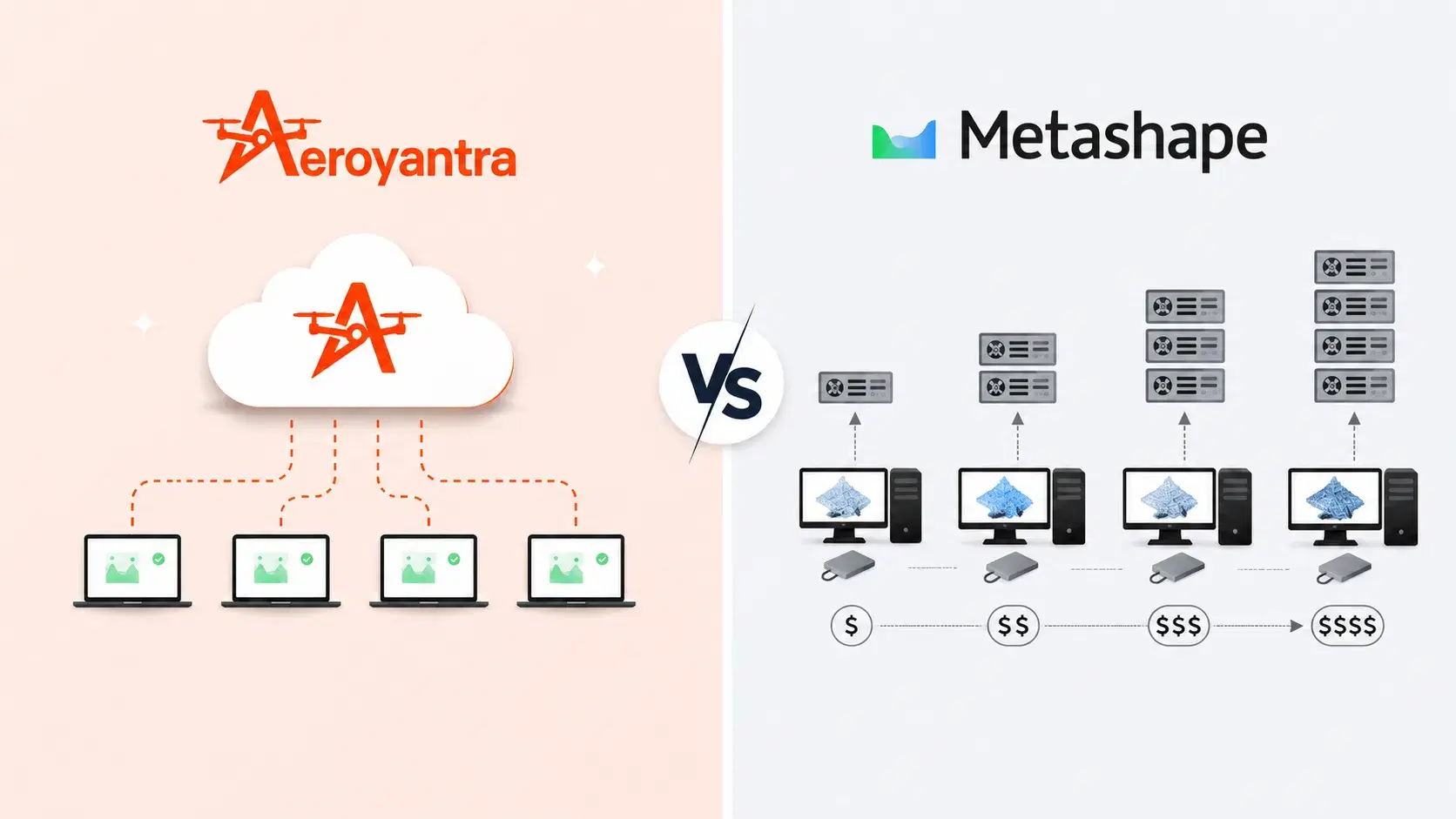
Agisoft Metashape Pricing 2026: $3,499 Cost & Alternatives
Metashape Professional is $3,499 one-time. Aeroyantra is $0 pay-per-use or $69/month. Honest comparison: desktop photogrammetry vs cloud survey platform. Hardware costs, features, accuracy for 2026.